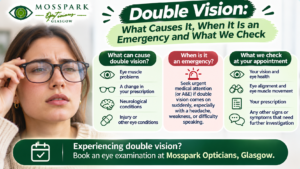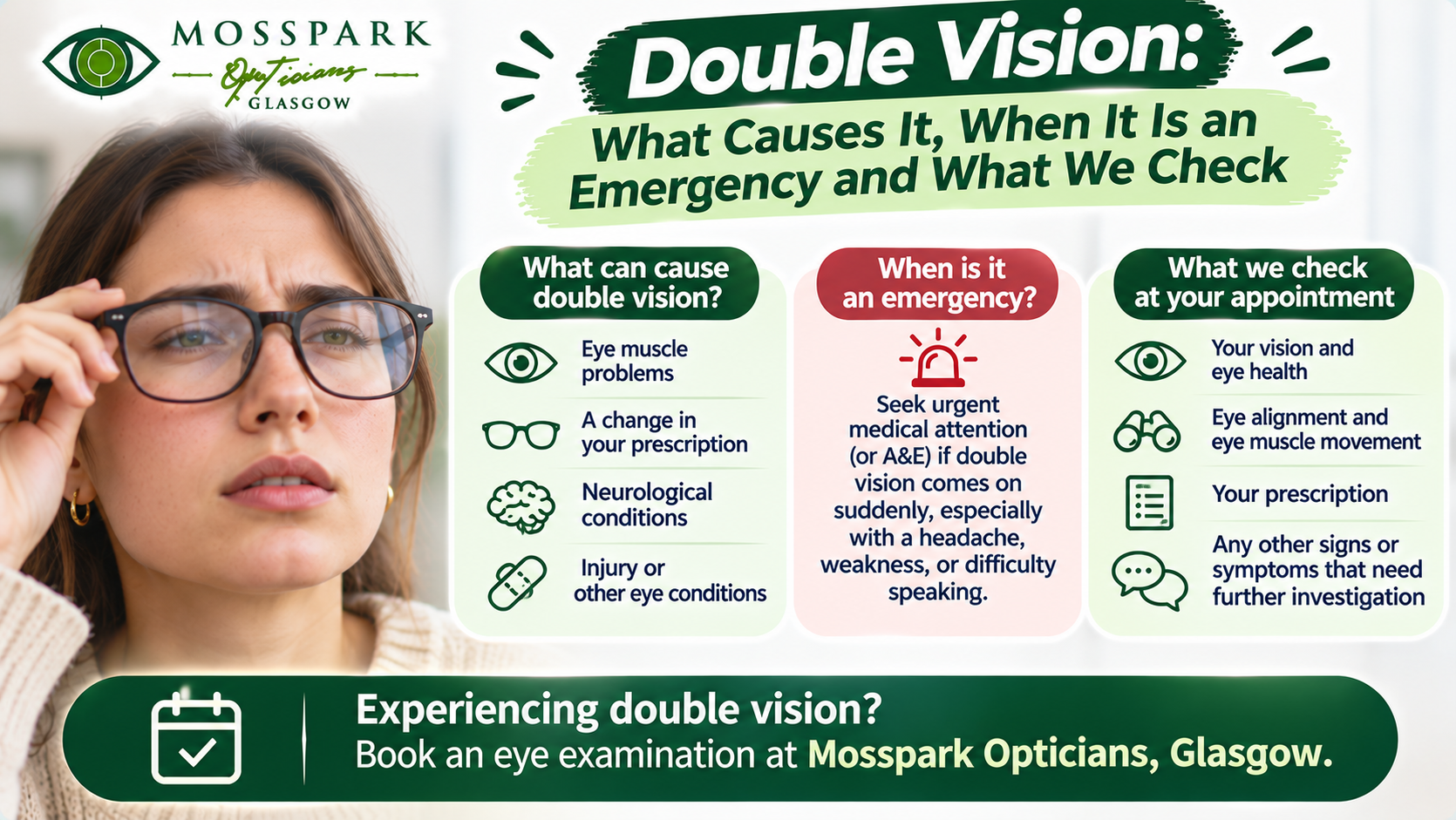

Double vision, or diplopia, means seeing two images of one object. If it started suddenly, especially with a headache, eye pain, weakness, slurred speech, a drooping eyelid or after a head injury, treat it as an emergency. If it has come on gradually or comes and goes, book an eye examination soon. Most causes can be found and treated.
Seeing double is unsettling, and people are often unsure whether it is serious. At Mosspark Opticians we see it in all age groups, from children with a squint to older adults with cataracts. This guide explains the quick test you can do at home, the common causes, and when to get help.
Cover one eye, then the other, while looking at something with a clear edge, such as a door frame.
Tell us which it is when you call, as it helps us decide how quickly we need to see you.
Children rarely say they are seeing double. Instead, they may tilt their head, cover one eye, close one eye in bright light, or turn their head to look at things. A squint that is not treated before about the age of seven can lead to a lazy eye, where the brain switches off the image from one eye. Read more about lazy eye and squint in children, or book a children’s eye test.
At an eye examination, we start with questions: whether the double vision came on suddenly or slowly, whether the images are side by side or one above the other, and whether it is worse looking in one direction. We then check:
If the cause is in the eye itself, we can usually treat it or correct it. If we think the nerves or the brain are involved, we will arrange an urgent referral to the hospital eye service or your GP, or a private referral if you prefer. For some people with long-standing double vision, a prism built into their glasses can bring the two images back together.
You should not drive while you have double vision. If it continues, you must tell the DVLA. Once the cause is treated or controlled, you may be able to drive again. Our guide to eyesight and driving explains the rules.
If you are seeing double, call Mosspark Opticians on 0141 427 4040, or visit us at 115 Airth Drive, Bellahouston, Glasgow G52 1JU.
Book your comprehensive eye examination or eyewear styling consultation with
Mosspark Opticians today.
It can be. If double vision starts suddenly, especially with a drooping face, weakness in an arm or leg, slurred speech or a severe headache, call 999 straight away.
If the double image stays when you cover your other eye, the cause is in that eye itself. Common causes are dry eye, astigmatism, an out-of-date prescription and cataract. It is less urgent than double vision in both eyes, but it still needs an eye examination.
Some people have a long-standing tendency for their eyes to drift apart, which they can normally control. When they are very tired, it can break through as double vision. Any new double vision still needs checking, even if it seems linked to tiredness.
Sometimes. If the cause is an uncorrected prescription or astigmatism, the right glasses can fix it. For some people with long-standing double vision, a prism built into the lenses can bring the two images together.
No. You should not drive while you have double vision, and if it continues, you must tell the DVLA. Once the cause is treated or controlled, you may be able to drive again.
Other Articles from Mosspark Opticians: