

You collect your new glasses, put them on, and something feels off. The floor looks slightly closer than it should, the edges of the room bend a little, or you have a dull ache by the evening. It is easy to decide that something has gone wrong.
Usually nothing has. Your brain has spent years reading the world through your old glasses, and it needs time to learn the new ones. Most of the time that takes a few days. Sometimes it is a sign that something needs adjusting, and the useful thing is knowing which is which.
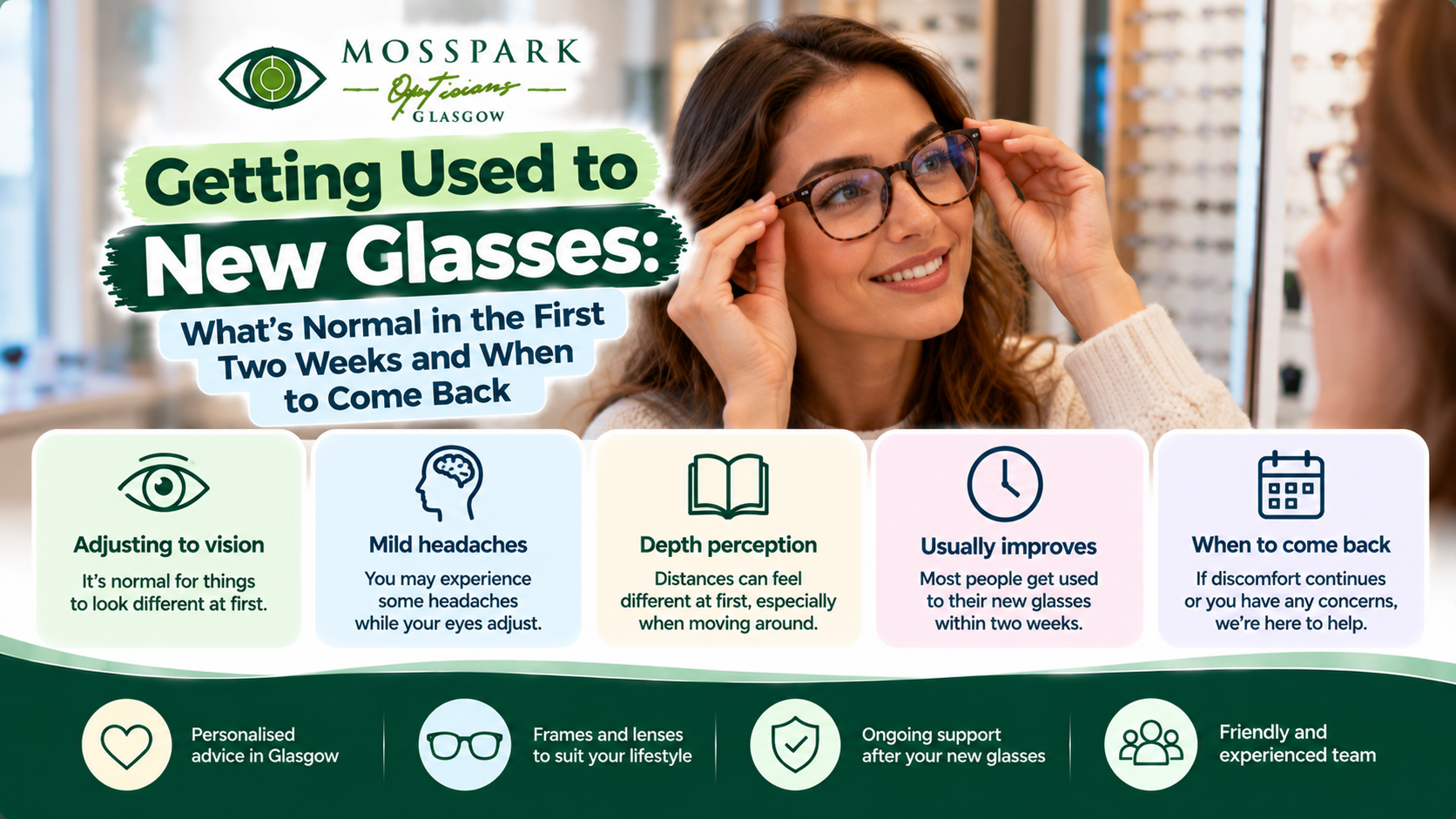
These are signs of your brain recalibrating. They should ease a little every day.
Glasses do more than make things sharp. They slightly change the size and position of what you see. When the prescription changes, especially the astigmatism part, the shape of things changes slightly too, and your brain has to adjust.
A new frame can do it as well, even with the same prescription. It sits at a different distance from your eyes or at a different angle, which shifts the optics. So does a change of lens type, such as moving to thinner lenses or to varifocals.
If you want to know what actually changed, I have explained the numbers in understanding your glasses prescription.
Come back if any of these happen.
None of these mean the examination was wrong. It might be the frame sitting differently, the centre of the lens not quite lining up with your eye, or a lens design that does not suit what you do all day. Most of these are quick to check and fix, and that is exactly what a follow-up is for.
A surprising number of “wrong prescription” complaints turn out to be the fit. If a frame has been bent, sits lower on one side, or slides down your nose, you are looking through the wrong part of the lens. A two-minute adjustment can make all the difference. Stronger prescriptions and thin high-index lenses are especially sensitive to where the lens sits, which is why fitting matters so much with our lenses.
Varifocals take more getting used to than single-vision lenses, because you are learning which part of the lens to use for each distance. I have covered that in my varifocal lenses guide. If you have just started wearing reading glasses, remember they are for close work only, and walking about in them will make the distance blurry. The options are in do I need reading glasses after 40?
If these are your first ever glasses, the adjustment is a slightly different experience, which I have described in getting your first pair of glasses as an adult. And if it has been a while since your last examination, the full appointment is explained on our eye examination page.
Book your comprehensive eye examination or eyewear styling consultation with
Mosspark Opticians today.
A mild headache or eye strain in the first few days can be normal while your eyes and brain adjust. If headaches get worse, start every time you wear the glasses, or have not eased after a week, have your glasses and prescription checked.
Glasses slightly change the size and position of what you see, particularly when the astigmatism part of the prescription or the frame changes. The brain usually adapts within a few days. Take stairs carefully at first, and see your optician if it does not improve.
No. Switching between old and new glasses slows down the adjustment. Wear the new pair full time from the morning, and put the old pair away unless your optometrist has advised otherwise.
Make sure they fit comfortably, let your child choose the style, make wearing them part of the daily routine, and tell the school. If a child keeps taking their glasses off, have the fit and prescription checked, as discomfort or blur is often the reason.
Go back if your vision is not improving after a week, or if you have double vision, worsening headaches, one eye clearer than the other, or a frame that is pressing, slipping or crooked. Many of these problems are fixed with a simple adjustment.
Other Articles from Mosspark Opticians: