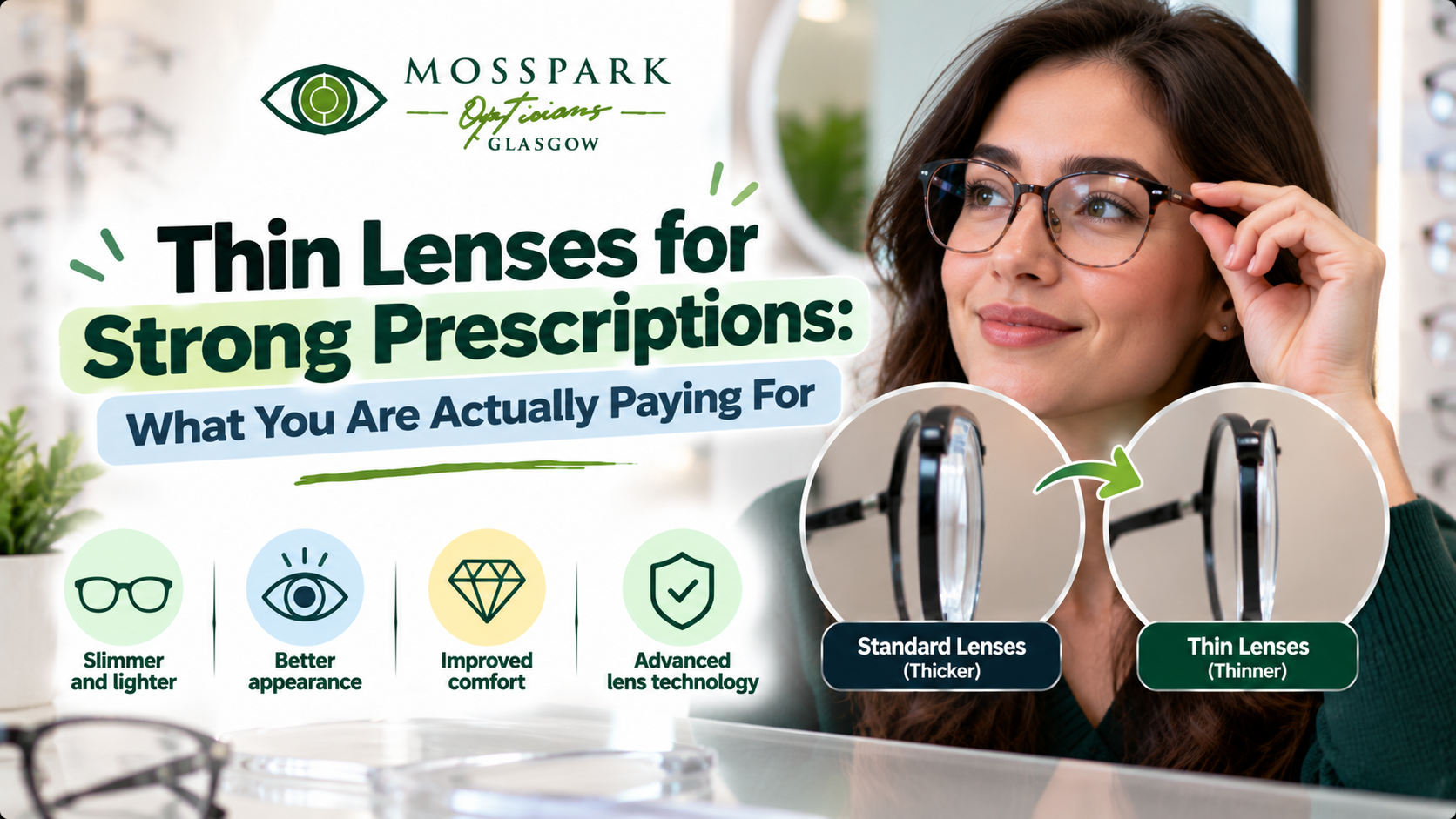


At some point in almost every pair of glasses I dispense, somebody asks whether they need the thinner lenses. It is a fair question, because they cost more and nobody ever explains what they actually are.
My honest answer is that it depends on two numbers and one decision: your prescription, the size of your frame, and how much the look and weight of your glasses matter to you. Sometimes thinner lenses are the best money you will spend. Sometimes they make no visible difference and I will tell you to keep it in your pocket.
A lens works by bending light. Different lens materials bend it by different amounts, and that is measured by a number called the refractive index. A material with a higher index bends light more, so it needs less of a curve, and less material, to do the same job.
Standard plastic lenses have an index of about 1.5. The thinner options you will hear named are 1.6, 1.67 and 1.74. The higher the number, the thinner and usually lighter the lens for the same prescription.
That is the whole idea. The prescription is identical and so is what you see. Only the amount of material changes.
It depends which way your prescription goes.
If you want to find those numbers on your own prescription, I have explained the layout in understanding your glasses prescription, and what the astigmatism figures mean in astigmatism explained.
Your prescription | What I would usually suggest | Why |
|---|---|---|
Up to about 2.00 | Standard 1.5 | The difference would be too small to see |
About 2.00 to 4.00 | 1.6 | A noticeable improvement at a modest cost |
About 4.00 to 6.00 | 1.67 | Edges and weight both come down clearly |
Above about 6.00 | 1.74 | The strongest prescriptions gain the most |
Those figures apply to plus or minus, and they are a starting point. A small frame can move you down a row, and a large one can move you up.
This is where it helps to choose frames with someone who knows your prescription. Our frame collection is picked with that in mind, and if these are your first glasses there is more on the choices in getting your first pair of glasses as an adult.
Thinner lenses are not better in every respect, and you should know the trade-offs before paying for them.
There is also a design feature worth asking about. An aspheric lens has a flatter front curve, which reduces thickness and the magnifying or shrinking effect on your eyes. For a strong prescription it often does as much for appearance as the material. The options I fit are on the lenses page.
A low prescription. Under about 2.00 you would be paying for a difference nobody could see.
If your prescription has gone up and you want to keep your frame, a higher index can keep the new lenses at the thickness you are used to. Whether the frame is suitable is a separate question, which I have answered in can you put new lenses in old frames.
And if you are moving into varifocals, the frame needs enough depth for the reading area as well, so thickness is only half of the decision. That is covered in my varifocal lenses guide.
Book your comprehensive eye examination or eyewear styling consultation with
Mosspark Opticians today.
As a rough guide, prescriptions up to about 2.00 gain very little, 2.00 to 4.00 suit a 1.6 lens, 4.00 to 6.00 suit 1.67, and stronger prescriptions gain most from 1.74. The size and shape of the frame can change that, so it is best decided with the frame in front of you.
A squint is where the eyes point in different directions. A lazy eye is reduced vision in one eye. A squint is one of the main causes of a lazy eye, but many children have a lazy eye with no squint, and both eyes look perfectly straight.
For moderate and strong prescriptions they usually are, because the lenses are visibly thinner and lighter. For low prescriptions the difference is too small to see. The step from 1.67 to 1.74 costs the most for the smallest improvement, so it is mainly worthwhile for the strongest prescriptions.
Usually because of the frame. A lens gets thicker the further it extends from its centre, so a large or wide frame produces a thick edge whatever the material. A smaller, rounder frame that centres your eyes well often reduces thickness more than moving to a higher index.
Yes. Higher-index materials reflect more light than standard lenses, which causes more glare and ghost images, especially when driving at night. An anti-reflection coating removes most of those reflections and should be treated as part of the lens rather than an optional extra.
Other Articles from Mosspark Opticians: