
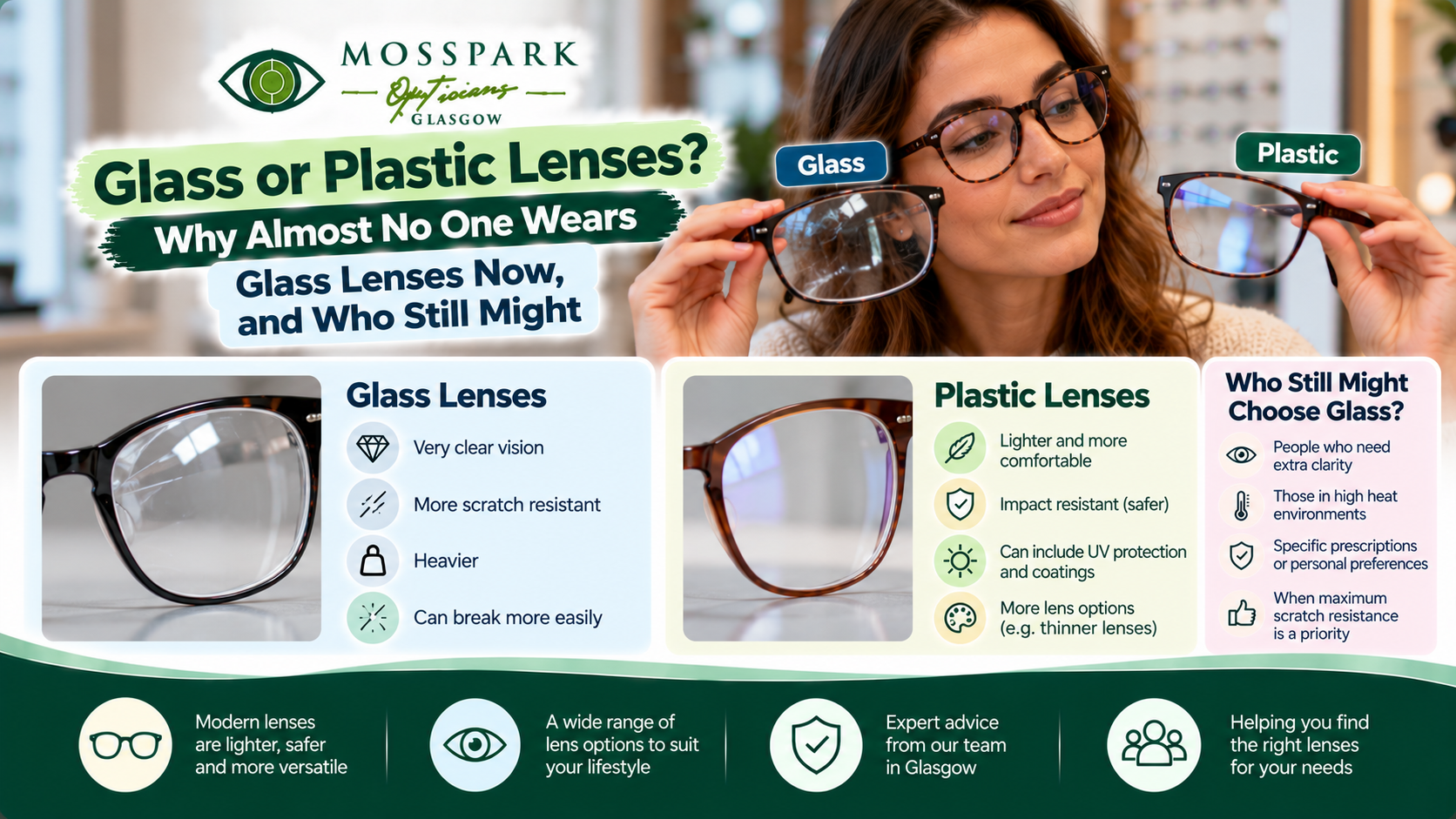

Every so often someone brings in a pair of glasses they have worn for years and asks for “the glass lenses again, please”. Their old lenses were glass, they never scratched, and they do not see why they should change.
It is a fair question. Glass was the standard material for spectacle lenses for most of their history, and it has some real strengths. But almost every pair of glasses made today has plastic lenses, and there are good reasons for that.
|
Glass |
Standard plastic |
Impact-resistant plastic |
|
|---|---|---|---|
|
Weight |
Heaviest, roughly twice standard plastic |
Light |
Light |
|
Scratch resistance |
Very good |
Good with a hard coat |
Good with a hard coat |
|
If it takes a knock |
Can shatter |
Can crack |
Very hard to break |
|
Optical clarity |
Excellent |
Very good |
Good |
|
Suitable for children and sport |
No |
Not ideal |
Yes |
The downsides are the reason it fell out of everyday use.
A small number of people still prefer glass. Usually they have worn it for decades, are used to the weight, and value the hard surface above everything else. If that is you, and your prescription and frame suit it, it is worth talking through. For most people, though, a good plastic lens with a quality hard coat and anti-reflection coating gives a lighter, safer pair of glasses with very little trade-off.
There is one group for whom glass is never the right answer. Children’s glasses and sports glasses should always have impact-resistant lenses. I have covered that in children’s glasses: frames that fit and actually get worn and in my sports eyewear discipline guide.
The material is only one decision. Thickness, coatings, and whether you need single vision, varifocals or tints all matter as much, and the right answer depends on your prescription and what you do all day. The full range is on our lenses page, and if these are your first glasses, getting your first pair of glasses as an adult is a good place to start.
Book your comprehensive eye examination or eyewear styling consultation with
Mosspark Opticians today.
Glass lenses are more scratch-resistant and give excellent clarity, but they are roughly twice as heavy as standard plastic and can shatter if they take a knock. For most people, a plastic lens with a good hard coat gives a lighter, safer pair of glasses with very little trade-off.
Glass spectacle lenses are still made, but they are now a specialist choice rather than the standard. They are not suitable for every frame or prescription, so ask your optician whether glass is an option for your glasses.
Glass is a much denser material than the plastics used for spectacle lenses. A glass lens is roughly twice as heavy as a standard plastic lens of the same prescription, which is most noticeable with stronger prescriptions.
An uncoated plastic lens scratches more easily than glass, but modern hard coatings make plastic lenses much more resistant. Careful cleaning with water and a microfibre cloth, and storing glasses in a case, prevents most scratches.
Often, yes. A frame in good condition can be fitted with tinted or polarised prescription lenses, which turns a pair you no longer wear every day into prescription sunglasses.
Other Articles from Mosspark Opticians:

Holiday Closure
We’ll be closed from 26th October to 9th November, reopening on 10th November.
Thank you for your understanding!
Team Mosspark Opticians