

We get asked for “sports glasses” most weeks, and it is never quite the right question. A swimmer and a winger need almost nothing in common. What suits a road cyclist would be a poor choice for someone playing squash, and actively unsafe for someone playing rugby.
So this is the guide we wish people had before they came in. Eleven disciplines, what usually works for each, and the mistake we see most often. If you would rather skip to yours, the table below is the short version. All of it sits under our sports optician service in Glasgow.
|
Discipline |
Usual answer |
The thing people get wrong |
|---|---|---|
|
Football |
Impact rated frame with retention, or contact lenses |
Wearing everyday frames in a contact environment |
|
Rugby |
Contact lenses for adults, impact frames for juniors |
Assuming a sports strap makes any frame safe |
|
Cycling |
Wrap frame, photochromic, vented |
Uncompensated curve causing edge distortion |
|
Running |
Light wrap or a secure everyday frame |
A tint too dark for shaded stretches |
|
Swimming |
Prescription goggles made to your correction |
Off-the-shelf goggles in rough half dioptre steps |
|
Golf |
Contrast tint, stable fit, careful with progressives |
A progressive lens fighting the address position |
|
Tennis & badminton |
Contrast enhancing tint, secure fit |
Frames that shift on the serve |
|
Squash |
Impact rated eye guards, non negotiable |
Playing in ordinary glasses or nothing at all |
|
Gym & strength |
Lightweight secure frame, anti fog |
Frames that slide during overhead work |
|
Climbing |
Secure light frame, or contact lenses |
Nothing that survives being pressed against rock |
|
Hillwalking |
Photochromic with side coverage, UV rated |
Underestimating glare and wind above the treeline |
Usual is not always. These are starting positions, not prescriptions. What suits you depends on your correction, your face, and how you actually play.
Before any of the specifics, there are three questions worth applying to anything you are considering. If it fails one, the rest does not matter much.
The most common enquiry we get, and the one where people arrive with the worst existing setup. Ordinary spectacles in a football environment slip when you sweat, sit badly if you head the ball, and put a rigid frame between an elbow and your eye socket.
What works: an impact rated frame in a flexible material that deforms rather than snaps, with proper head retention, and polycarbonate or Trivex lenses as standard. For adult players, contact lenses are frequently the cleaner answer altogether: nothing to displace, full peripheral field, no frame in the tackle.
Higher contact, same logic, applied harder. For most adult players we would steer towards contact lenses. For junior players we lean back towards impact rated frames, partly for handling and hygiene reasons, partly because parents can see whether a frame is being worn.
A strap on an ordinary frame does not make it a sports frame. It keeps a non-impact-rated frame attached to your face, which is not the same as making it safe.
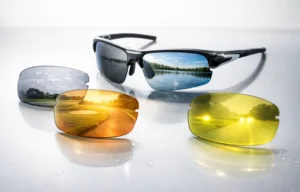
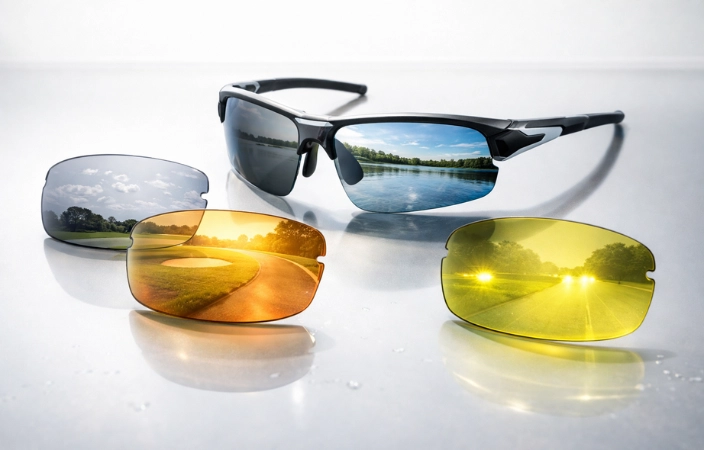
This is where lens technology genuinely earns its money, and where prescription wearers are most often let down by generic solutions.
Lower stakes than cycling because you are moving more slowly, but the same tint logic applies and stability matters more than people expect over distance. A light wrap works well. So, often, does a good everyday frame that has been properly adjusted, which is worth knowing before you spend.
On tints for road and towpath use: avoid anything very dark. You need to read the surface in shadow as well as in sun, and a tint chosen on a bright day becomes a hazard under trees or in an underpass.
Frequently underestimated. Light levels above the treeline are considerably higher than at street level, glare off wet rock and snow is significant, and wind exposure over several hours dries the eyes badly. Photochromic lenses with reasonable side coverage and a proper UV rating, and if your eyes stream in wind, mention it, because that is often treatable rather than inevitable.
The most immediately satisfying fitting we do, and the most neglected. Prescription swimming goggles are made to your actual correction rather than sold in rough half dioptre steps off a shelf, which is what most people have been putting up with.
Being able to read the pace clock, see the wall coming and follow a coach’s hand signals changes a session completely. Fit around the orbit matters more than the strap: a goggle that leaks is a goggle that comes off. Worth pairing with dry eye advice if chlorine irritation is an issue, which it usually is for regular pool swimmers.
Contrast is what helps here: lifting a ball out of grass or sky, and reading the break on a green. Two specific cautions. First, think about how the lens copes with the transition from bright fairway to shaded green. Second, if you wear a progressive lens, be aware that the reading portion sits exactly where you are looking when you address the ball, which some golfers find genuinely disruptive. There are ways around it, and it is worth raising at the fitting.
Fast, small objects against busy backgrounds, so contrast enhancing tints do real work. The fit has to survive the rotation and overhead extension in a serve, which rules out most everyday frames without adjustment.
The one place in this guide where we would be firm rather than advisory. A squash ball fits the eye socket almost exactly and travels fast in a confined space. Impact rated eye guards are strongly recommended for everyone, corrected or not, and are mandatory for juniors in many club and competition settings. If you play squash in ordinary glasses, please change that.
Lower impact risk, higher demands on stability, because the frame spends a lot of time inverted, tilted or pressed against a bench. Lightweight and secure matters most, and anti fog treatment is worth more indoors than people expect in a warm studio. Many people are well served here by a good everyday frame, correctly adjusted, rather than a dedicated sports frame.
Similar demands with an added complication: your face spends time close to rock or a wall, and a protruding frame is both a scratch risk and a nuisance. Low profile, secure, and light. Plenty of climbers find contact lenses simpler for exactly this reason.
The honest answer is that it depends on the sport, not on preference alone. As a rough guide:
This is the part that gets skipped, and it is the part that matters most. A sports frame with an inaccurate prescription inside it is still an inaccurate pair of glasses, and you will have paid a premium for the privilege.
A comprehensive eye examination at Mosspark runs a full forty minutes and includes OCT retinal imaging, carried out by a GOC and IP registered optometrist with over twenty years of experience. That is not padding. It is the difference between a screening and an examination, and it is how we find the things people had no idea were affecting them: early dry eye explaining discomfort in wind, or a small uncorrected astigmatism explaining why both night driving and evening sport feel harder than they should.
We work this way deliberately. It is what we mean by Slow Optometry. Your optometrist, unhurried, for the whole appointment, with nobody standing between you and the person doing the testing.
If a child plays club sport, act on this rather than filing it away. Children’s frames take a hammering, young eyes are still developing, and vision problems in children usually surface as “not concentrating” or “gone off it a bit” long before anyone thinks to check their eyes. Where short sightedness is progressing year on year, myopia management can slow that progression, and it is considerably more useful started early than late.
Book your comprehensive eye examination or eyewear styling consultation with
Mosspark Opticians today.
Sports eyewear is prescription or protective eyewear designed for a specific activity rather than for everyday wear. It covers impact resistant frames and lenses, wrap-around designs for cycling and running, prescription swimming goggles, contrast enhancing tints and photochromic lenses. The defining feature is that it is fitted to both your prescription and the demands of your sport.
For low-impact indoor training a well-adjusted everyday frame is often adequate. For contact sport, cycling, swimming or anything involving a fast-moving ball, everyday frames are the wrong tool. They slip when you sweat, they are not impact rated, and in contact sport a rigid frame near the eye socket is a genuine injury risk.
In most cases yes. Strong prescriptions in wrap frames need careful compensation for the curvature of the frame, which is specialist work rather than a standard order. Bring your current prescription to an appointment and we will tell you honestly what is achievable and where the practical limits sit for your particular correction.
It varies considerably with the frame, the lens material, the tint and the strength of your prescription, so a single headline figure would be misleading. We would rather talk it through at the fitting so you know exactly what you are paying for and why. Ask us for a written quote before you commit to anything.
It depends on the sport. Contact lenses tend to win in contact sport, where a full peripheral field matters, and wherever a frame sits awkwardly under a helmet or goggles. Frames tend to win outdoors, where you also want protection from wind, debris, glare and UV. Many athletes use both, in different sessions.
For outdoor use here, avoid very dark fixed tints. The light changes too much within a single session, and a tint chosen for bright conditions becomes a hazard in shade. Photochromic lenses that adapt as conditions change are usually the better choice, with contrast enhancing tints worth considering specifically for ball sports.
Yes, and they are one of the most immediately noticeable upgrades we fit. Prescription goggles are made to your actual correction rather than sold in rough half dioptre steps, so you can read the pace clock, judge the wall and follow a coach rather than guessing at all three. Fit around the eye socket matters more than the strap.
Impact rated eye guards are strongly recommended for all squash players, and are mandatory for juniors in many club and competition settings. A squash ball fits the eye socket almost exactly and travels at speed in a confined space. This is the one sport where we would advise protective eyewear regardless of whether you need correction.
Other Articles from Mosspark Opticians: