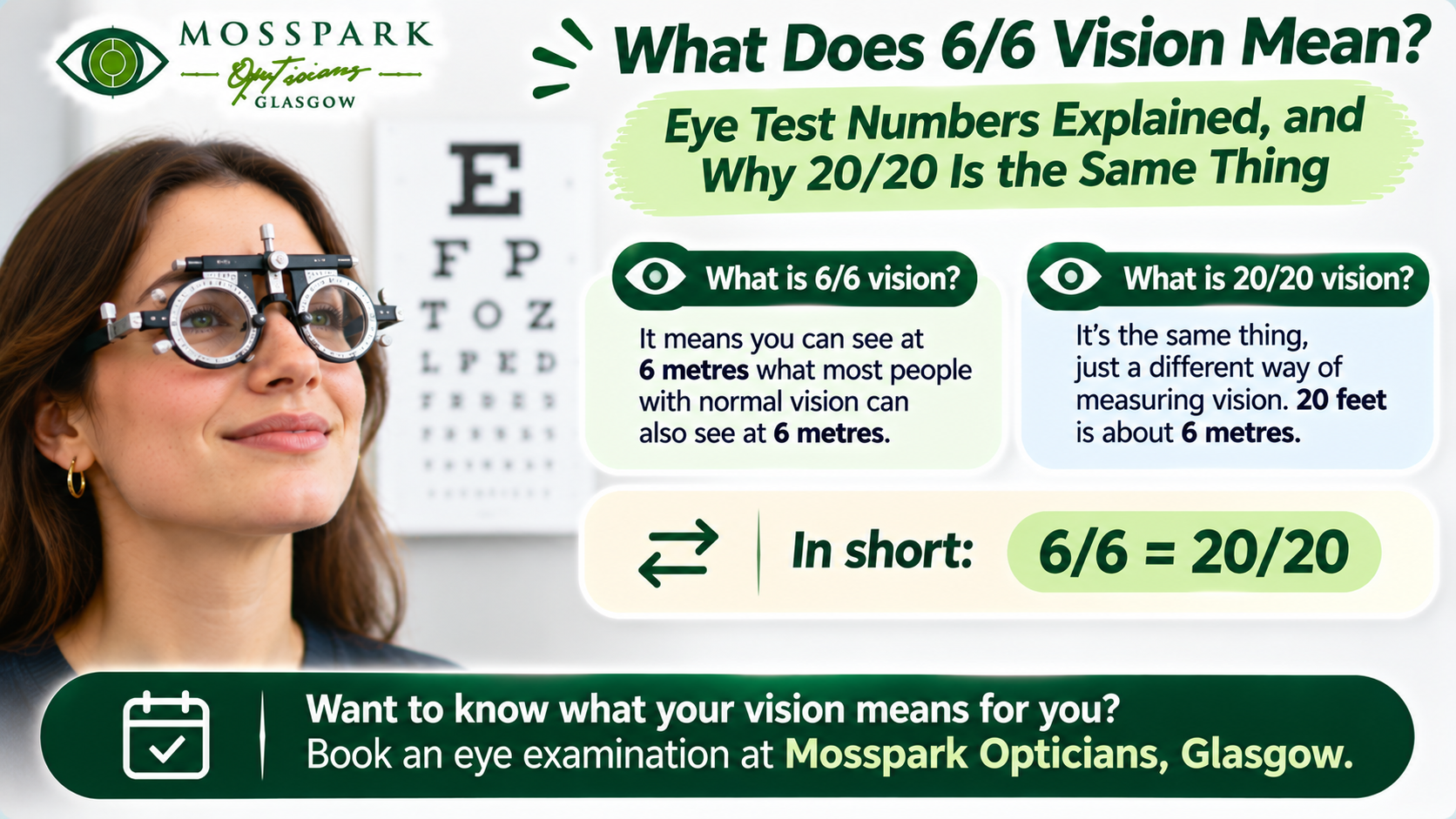
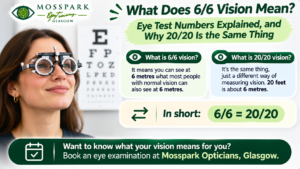

6/6 vision means that from 6 metres away, you can read what a person with normal sight can read from 6 metres. It is the UK way of writing 20/20, which is measured in feet. 6/6 is good, average vision, not perfect vision, and it only measures how sharply you see at a distance.
After an eye test, patients often ask us at Mosspark Opticians what their numbers mean. It does not help that there are two sets of numbers: your vision score and your glasses prescription. This guide explains the vision score, and what it does and does not tell you.
A vision score has two numbers. The top number is the distance you were tested at, which in the UK is usually 6 metres. The bottom number is the distance at which a person with normal sight could read the smallest line you managed.
So if your vision is 6/12, you need to be 6 metres away to read a line that a person with normal sight could read from 12 metres. The bigger the bottom number, the less sharp the vision.
Score | What it means |
6/4 or 6/5 | Sharper than average, common in young adults |
6/6 | Normal, good vision (the same as 20/20) |
6/9 | Slightly below average, still good |
6/12 | The minimum needed to drive, with both eyes together |
6/18 to 6/36 | Noticeably blurred at a distance |
6/60 | Can only read the largest letter on the chart |
You may also see a decimal score. 1.0 is the same as 6/6, and 0.5 is the same as 6/12.
Your vision score describes how well you see, with or without glasses. Your prescription is the power of the lenses needed to correct your sight. They are related but different. Many people need glasses and see 6/6 once they are wearing them. If you want to understand the numbers on your prescription, read what your glasses prescription means.
The letter chart measures one thing: how sharply you can see small detail at a distance, in good light. It does not test:
That last point matters most. Conditions such as glaucoma can cause serious, permanent damage while your vision is still 6/6. That is why a full eye examination checks far more than the letter chart. Here is what an eye test can detect.
Young children cannot always read letters, so we use pictures, shapes or letter-matching games instead. Their vision is still developing in the early years, so the expected score depends on their age. A difference between the two eyes matters more than the exact number, because it can be a sign of a lazy eye that is best treated early. Read what age children should have their eyes tested, or book a children’s eye test.
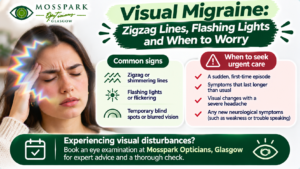
After a first visual migraine, an eye examination can rule out eye causes. We check the retina for tears and other problems, look at the optic nerve, and test your field of vision if it is needed. If your eyes are healthy and the description fits migraine, we will suggest you see your GP about managing it.
Eye strain itself does not cause a migraine aura, but an out-of-date prescription can add to headaches in people who already get migraines. Our guide to headaches and your eyes explains how to tell eye-related headaches apart. If a visual change comes on suddenly and does not fit the pattern above, our emergency eye care guide explains where to go.
Not always. If your vision is reduced by something other than a focusing error, such as a cataract, a lazy eye or a condition affecting the macula, glasses alone may not bring it back to 6/6. If your best corrected vision has dropped, that is a sign we need to look more closely at the health of your eyes. For example, cataracts are one of the most common reasons.
To find out your vision score and check the health of your eyes, call Mosspark Opticians on 0141 427 4040, or visit us at 115 Airth Drive, Bellahouston, Glasgow G52 1JU. NHS eye examinations are free in Scotland.
Book your comprehensive eye examination or eyewear styling consultation with
Mosspark Opticians today.
Yes. They mean the same thing. 6/6 is measured in metres and 20/20 in feet. Both mean you can see at the test distance what a person with normal sight can see at that distance.
Not at all. 6/9 is slightly below average but still good, and it is well above the standard for driving. It may simply mean your glasses need updating.
You must be able to read a number plate from 20 metres and have vision of at least 6/12 (0.5 decimal) with both eyes open, wearing glasses or contact lenses if you need them. You also need a wide enough field of vision.
No. 6/6 only measures how sharply you see at a distance. Conditions such as glaucoma can cause serious damage while your vision is still 6/6, which is why a full eye examination checks much more than the letter chart.
Yes. Many young adults see 6/5 or even 6/4, which means they can read smaller letters than average from the same distance.
Other Articles from Mosspark Opticians: