


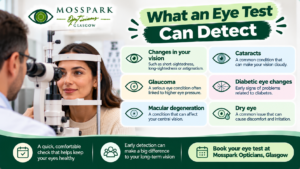
Most people think of an eye test as a way to find out whether they need glasses. So what can an eye test detect beyond that? Quite a lot. The back of the eye is the only place in the body where a clinician can look directly at blood vessels and a nerve without a scan or a procedure, and what we see there can reflect what is happening elsewhere in the body.
This article explains what a thorough eye examination can pick up, and why it is worth keeping yours up to date even when your vision feels fine.
Glaucoma
Glaucoma damages the optic nerve, usually without any early symptoms. By the time people notice a change in their vision, some damage has often already happened, and that damage cannot be reversed. An eye examination checks the optic nerve, the eye pressure and, where needed, the field of vision. Read more about glaucoma, family history and what an OCT scan shows.
Macular degeneration
Age-related macular degeneration affects the centre of your vision, the part you use to read and recognise faces. Early changes at the macula can often be seen before you notice them yourself, particularly with an OCT scan.
Cataracts
A cataract is a gradual clouding of the lens inside the eye. An eye examination can spot one early and track how quickly it is changing, so a referral can be made at the right time.
Retinal problems
Tears, holes and other changes in the retina can be seen during an examination, sometimes before they cause symptoms. New flashes or floaters always need checking promptly.
Diabetes
Diabetes can damage the tiny blood vessels at the back of the eye. Occasionally an eye examination is the first place that signs of diabetes are noticed, in someone who has not yet been diagnosed. If you already have diabetes, our article on diabetic eye screening and your eye test explains why you need both.
High blood pressure
Raised blood pressure can cause visible changes in the blood vessels of the retina, such as narrowing, nicking where vessels cross, or small bleeds. Many people with high blood pressure feel perfectly well, so these signs can be an important early warning.
High cholesterol
In some people, particularly younger adults, a pale ring around the edge of the cornea or small deposits in the retinal blood vessels can suggest raised cholesterol.
Less common conditions
Rarely, an examination can show signs linked to thyroid eye disease, inflammation elsewhere in the body, conditions affecting the nervous system, or raised pressure around the brain, which causes swelling of the optic nerve. These are uncommon, but they are one reason a careful look at the back of the eye matters.
Many of the conditions above cause no symptoms in their early stages. Good vision does not mean healthy eyes. Regular examinations are how problems are caught while they are easiest to manage.
On the NHS in Scotland, eye examinations are free for everyone. Most adults aged 16 to 59 can have one every two years, and under-16s and over-60s every year. You may be offered checks more often if you have diabetes, glaucoma or a family history of glaucoma. Find out more about free NHS eye tests in Scotland.
Looking properly at the health of the eye takes time, and our appointments are never rushed. Find out more about our eye examinations in Glasgow or about us as an independent optician in Glasgow’s Southside.
To book your eye examination, call us on 0141 427 4040.
Book your comprehensive eye examination or eyewear styling consultation with
Mosspark Opticians today.
As well as your glasses prescription, an eye test can detect eye conditions such as glaucoma, cataracts and macular degeneration, and signs of general health conditions such as diabetes and high blood pressure.
An eye examination can show changes in the blood vessels at the back of the eye that may be caused by diabetes. If we see these signs, we refer you to your GP for tests.
It can show changes in the retinal blood vessels linked to high blood pressure. It does not measure your blood pressure, so your GP will confirm it.
Rarely, an eye examination can show swelling of the optic nerve caused by raised pressure around the brain, which needs urgent investigation. This is uncommon.
Most adults can have a free NHS eye test every two years, an
Other Articles from Mosspark Opticians:

Holiday Closure
We’ll be closed from 26th October to 9th November, reopening on 10th November.
Thank you for your understanding!
Team Mosspark Opticians