
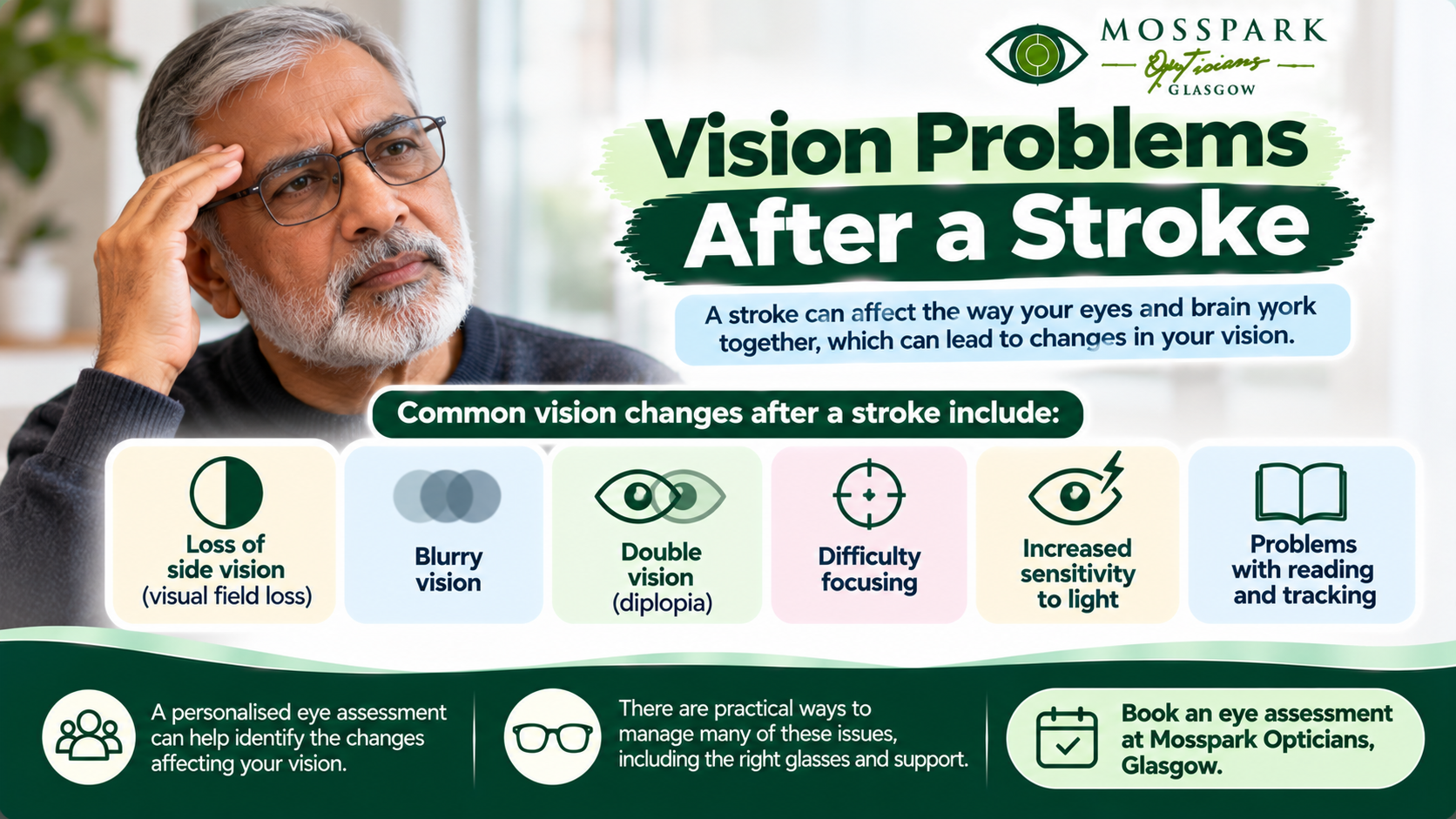

Vision problems after stroke are very common, but they are often overlooked while the focus is on movement, speech and getting home from hospital. A stroke can affect the parts of the brain that handle what we see, even when the eyes themselves are healthy.
If you have had a stroke, or you care for someone who has, this article explains what to look out for and the help that is available.
Sight depends on the brain as much as the eyes. The eyes collect the image, but the brain processes it and makes sense of it. A stroke that damages the visual pathways in the brain can change what a person sees, how their eyes move together, or how they understand what is in front of them.
Loss of part of the visual field
The most common problem is losing vision on one side, often the same half of vision in both eyes. People may bump into door frames on one side, miss food on one side of the plate, or not notice someone standing to their left or right.
Double vision or blurred vision
A stroke can affect the nerves and muscles that move the eyes, so the eyes no longer point in exactly the same direction. This can cause double vision, blurring, or difficulty keeping words still when reading.
Visual neglect
Some people stop paying attention to one side of their world, even though their eyes can see it. They often do not realise it is happening, so family and carers are usually the first to notice.
Difficulty making sense of what they see
Recognising objects or faces, judging distances and reading can all become harder, even when vision itself is clear.
Sensitivity to light
Bright light and glare can become uncomfortable after a stroke, and busy environments can feel overwhelming.
Bumping into things or door frames, especially on one side
Support is available, and some vision problems improve on their own over the weeks and months after a stroke. An eye examination is a good starting point. We check whether the eyes themselves are healthy, whether glasses need updating, how the eyes are working together and, where appropriate, the field of vision.
Depending on the problem, help can include:
A stroke can affect whether it is safe and legal to drive, particularly if part of the visual field has been lost. Follow your doctor’s advice and the DVLA guidance before getting behind the wheel again. Our article on eyesight and driving explains the vision standard every driver has to meet.
Getting to a practice is not always possible after a stroke. If someone cannot leave home on their own because of their health, they may qualify for a free NHS home eye test in Glasgow. We bring portable equipment to them, and family members and carers are always welcome to be there. We can carry out the visit in English, Urdu or Punjabi.
Find out more about our home visit eye care and about us as an independent optician in Glasgow’s Southside.
To arrange an eye test after a stroke, at the practice or at home, call us on 0141 427 4040.
Book your comprehensive eye examination or eyewear styling consultation with
Mosspark Opticians today.
Yes. Vision problems are common after a stroke, including loss of part of the visual field, double vision, visual neglect and difficulty making sense of what you see.
Some vision problems improve naturally in the weeks and months after a stroke. Others can be helped with glasses, prisms and practical strategies.
Yes. An eye examination checks the health of the eyes, updates glasses and can identify vision problems caused by the stroke.
If you cannot get to a practice on your own because of your health, you may qualify for a free NHS home eye test in Scotland.
It depends on your recovery and your vision. Follow your doctor's advice and DVLA guidance before driving again.
Other Articles from Mosspark Opticians:

Holiday Closure
We’ll be closed from 26th October to 9th November, reopening on 10th November.
Thank you for your understanding!
Team Mosspark Opticians