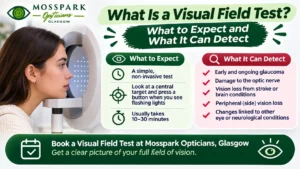

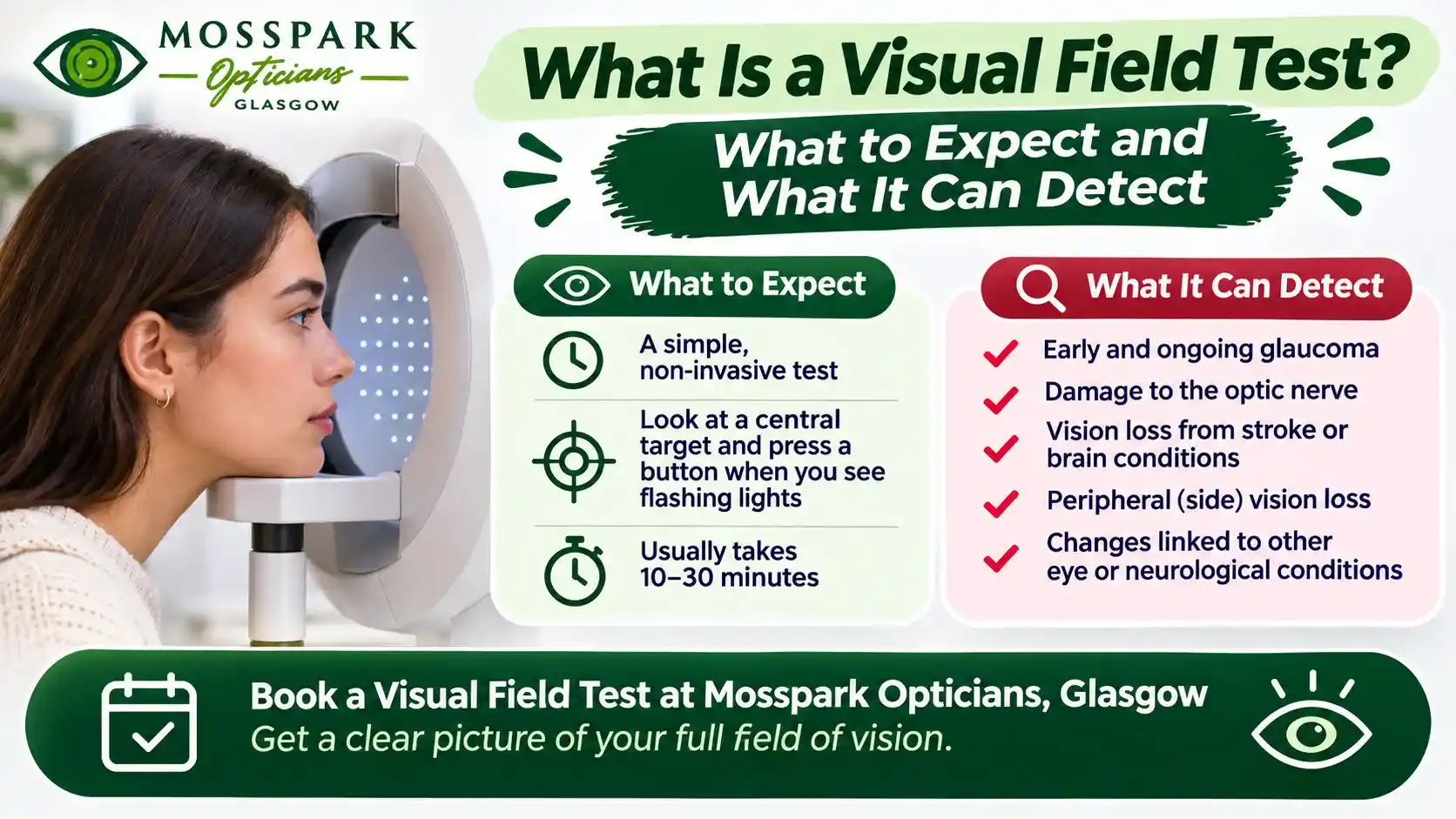
A visual field test, also known as a visual field assessment, visual field examination or peripheral vision test, measures how much you can see across your whole area of vision, from the point you are looking at out to the far edges. We use it to look for patches of reduced sensitivity, most often when checking for or monitoring glaucoma. It does not hurt and nothing touches your eye, but it can feel strange the first time: you stare at a fixed target and press a button whenever you notice a faint flash of light.
The short version
Your visual field is everything you can see at once without moving your eyes. A visual field assessment checks both your central vision and your peripheral (side) vision.
You may also hear it called a visual field eye test, a field of vision test, an eye field test or, in clinics, a perimetry eye test. They all describe the same idea: mapping what you can see around the point you are looking at.
It asks a different question from a letter chart. The chart measures visual acuity, which is how sharp your central vision is (we explain those numbers in what 6/6 vision means). A field test asks how much you can detect around the point you are looking at, and how faint a light can be before you stop seeing it.
So you can read the bottom line of the chart and still have a patch of reduced vision. Field loss is usually slow, and the brain fills in gaps so well that people often do not notice mild loss. That is why it is not something you can check for yourself at home. Side vision also matters for everyday tasks such as driving, and our guide to eyesight and driving covers the standards.
The test tells us how your vision is working, not just how your eye looks. We might suggest one to:
It is one piece of the picture. The result is read alongside the rest of your examination, and it is only one part of the assessment needed to make a diagnosis. It is also not part of every eye test: whether you need one depends on your history, your symptoms and what we find.
Most practices use automated perimetry, the technical name for an automated visual field test. The most common is the Humphrey test, which uses a bowl-shaped instrument, often called a visual field machine or analyser, that shows lights one at a time. Details vary with the equipment and the reason for the test.
You sit comfortably with your chin and forehead resting on supports, and one eye is usually covered while the other is tested. The examiner decides whether you wear your own glasses or whether the instrument corrects your vision, so please bring all your glasses, including reading glasses.
You keep looking at a fixed target in the centre throughout. Lights flash at different places and different brightnesses, and you press the button each time you see one.
The test is looking for the dimmest light you can see, so some are deliberately very faint and it is normal not to see a light every time. There may be stretches when nothing seems to happen. Blink as you normally would, keep your head still, and keep looking at the target even when you cannot see any lights.
The instrument tracks whether your gaze stays on the target and whether you press when no light has appeared, so an odd mistaken click is unlikely to matter. If you are tired, unsure what to do or uncomfortable, tell us. We would much rather pause than have you struggle through.
The instrument produces a map of your results, which is compared with typical results for people your age. We review it with the rest of your examination and explain what it means for you.
It can show patterns of reduced sensitivity that may need further investigation. It does not name a condition by itself.
A visual field test can detect the effects of glaucoma, but it cannot diagnose the condition on its own. Glaucoma damages the optic nerve, and the earliest loss is often in the peripheral field. If you have glaucoma, you may miss some of the flashing lights. For suspected chronic open angle glaucoma, NICE recommends automated visual field assessment alongside optic nerve assessment, OCT where available and eye pressure measurement before referral. That guidance applies to England, but it shows how the tests fit together.
It is also worth knowing that an optometrist does not diagnose glaucoma, and a referral does not mean you definitely have it. For family history and imaging, see our guide to glaucoma and OCT imaging.
Visual field tests help to diagnose and monitor conditions affecting the retina, the optic nerve and the visual pathway. Different conditions tend to leave different patterns, which is why results need professional interpretation.
The visual pathway runs from the eye back through the brain, so conditions affecting it can also change the field of vision. If a pattern points that way, we can arrange further medical assessment. Interpreting a field map is a job for a trained clinician, not something to work out from a printout.
Expect a few minutes per eye for a standard automated test. NHS leaflets quote anything from 3 to 5 minutes to 5 to 10 minutes per eye, and the moving-target Goldmann test can take up to 30. The difference comes from the equipment, the testing strategy, the reason for testing, how well you can concentrate and whether one or both eyes are tested. Allow a little extra time to settle in and hear the instructions.
There is little to prepare for a visual field test, but a few habits help.
The visual field analysis printout is a map of how sensitive your vision is at many points across the field. Some areas respond as expected for your age. Others may show reduced sensitivity, which we look at for pattern, position and consistency. A cluster of reduced points is called a visual field defect.
Two things matter as much as the map. One is reliability: a test where your gaze drifted or you were very tired is harder to trust. The other is context: we read the map alongside your eye pressure, the appearance of the optic nerve, any imaging and your history. A normal result is reassuring but does not rule out every eye condition, and a reduced area does not by itself tell us why it is there.
Repeating the test is common. We might ask you to repeat it to set a reliable baseline, because the first attempt is often a practice run, because you were tired or distracted, to see whether an unexpected result happens again, or simply to monitor change over time. NHS guidance notes that repeating the test improves reliability and helps track changes. Being asked to come back does not mean a serious condition has been found.
The simplest way to separate them is function versus structure. A visual field test measures how your vision performs. An OCT scan images the tissue itself.
|
Visual field test |
OCT scan |
|
|
What it measures |
How well you detect faint lights across your field of vision |
Cross-sectional images of the retina and optic nerve head |
|
Type of information |
Function: what you can see |
Structure: what the tissue looks like |
|
Typical use |
Finding and monitoring areas of reduced vision |
Looking at retinal layers, including the nerve fibre layer, and tracking structural change |
|
What you do |
Respond to lights with a button; needs sustained attention |
Keep your eye still while images are captured; no responses needed |
|
Together |
Shows whether damage is affecting vision |
Can show structural change before the field is affected |
In glaucoma assessment the two give complementary information, and neither replaces the other. Our article on how OCT helps assess the optic nerve goes further.
We recommend a visual field test according to your symptoms, risk factors, earlier findings and clinical judgement. If you have a family history of glaucoma, or you have noticed something unusual at the edges of your vision, tell us at your next eye examination so it can shape what we check.
Some changes should not wait for a routine appointment. In Scotland, contact an optometrist urgently if you notice a sudden loss of vision, sudden flashes or new floaters, or a dark curtain or shadow moving across your vision. These can be signs of a problem at the back of the eye such as a detached retina, where early treatment matters. If the practice is closed, call NHS 24 on 111. Our page on emergency eye care explains what to do.
If sudden vision changes come with facial drooping, weakness in an arm or slurred speech, call 999.
Mosspark Opticians is an independent opticians in Glasgow, based at 115 Airth Drive in Bellahouston. If you are looking for a visual field test in Glasgow, the usual starting point is an eye examination. Our comprehensive eye examination in Glasgow includes assessing the health of the eye, and we carry out pressure and field tests where they are needed for your situation, so a visual field assessment can be part of your appointment when your optometrist recommends it. If a specialist opinion would help, we will talk you through the options, including specialist eye care referrals.
If you have been advised to have a visual field assessment, or you have questions about your peripheral vision, you can book an eye test in Glasgow by calling us on +44 141 427 4040 or getting in touch online. An eye examination is the best way to find out which tests are right for you.
Book your comprehensive eye examination or eyewear styling consultation with
Mosspark Opticians today.
Yes. Some people get the zigzag lines or blind spot of a migraine aura with no headache at all. It is more common as people get older. The first time it happens, it is worth getting your eyes checked.
That is expected. The test deliberately includes lights near the limit of what anyone can see. Keep looking at the target and press only when you see a light.
It depends on the equipment. Some instruments correct your vision internally, because frames can block part of your side vision, so the examiner decides. Bring all your glasses anyway.
Not necessarily. Tiredness, an unreliable test, cataract and other eye or nerve conditions can all affect a result. We look at the whole picture and may repeat the test or arrange further assessment before drawing conclusions.
No. Whether you need one depends on your history, symptoms and findings. If you are unsure why it has or has not been suggested, just ask.
Other Articles from Mosspark Opticians: