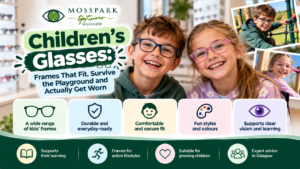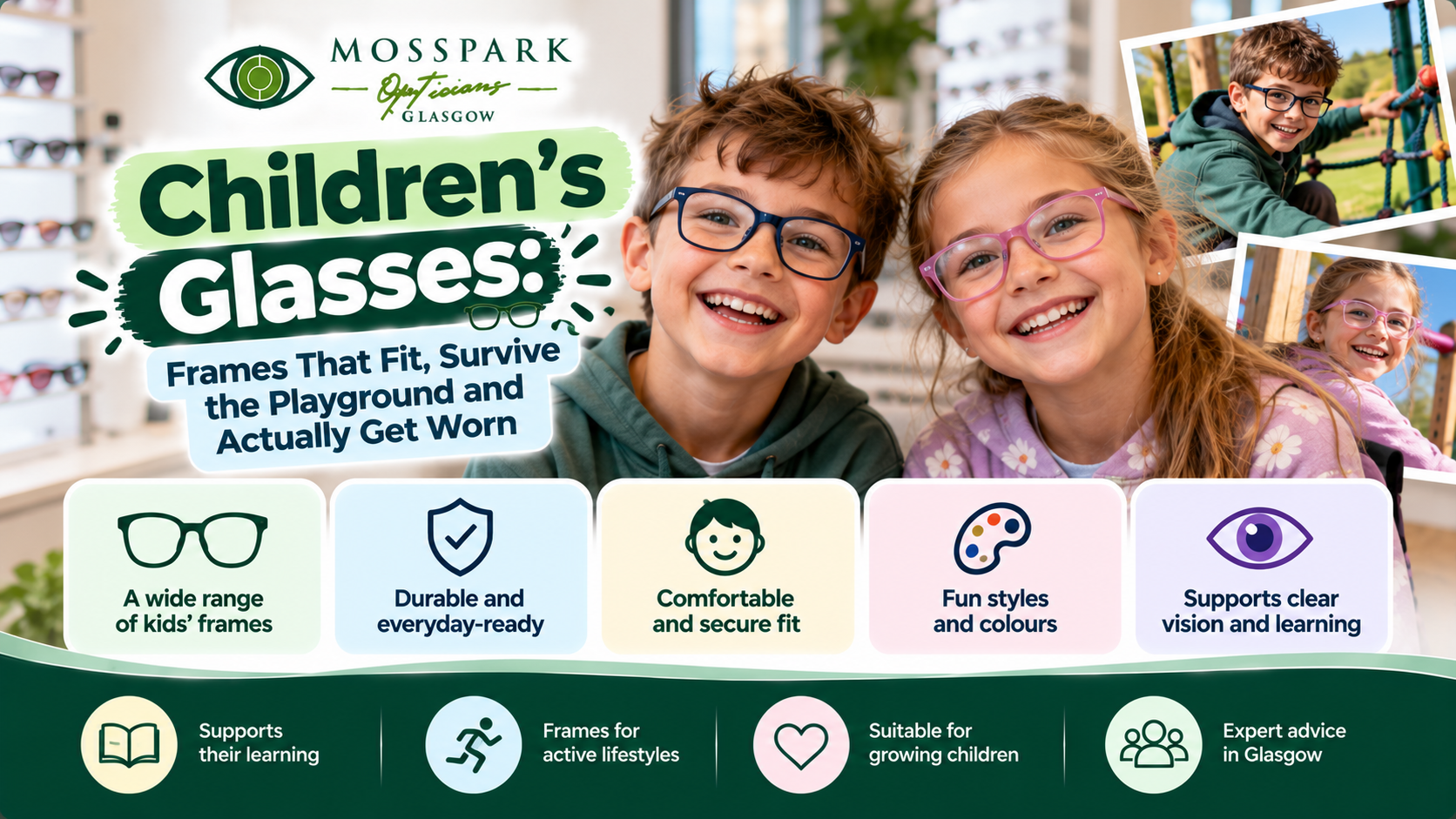

A child who has just been told they need glasses usually reacts in one of two ways. Some are delighted and want to wear them in the bath. Others would rather not see the board than be the only one in the class with glasses.
Either way, the glasses only work if they are worn, and the biggest single factor in whether a child wears them is whether they are comfortable. That comes down to the fit, the frame and the lenses.
Children’s faces are not small adult faces. Their noses are flatter, the bridge is lower and their heads grow quickly. An adult frame in a small size usually slides down, so the child ends up looking over the top of the lenses.
Soft, flexible frames, often in one piece, with a strap or sides that curl around the ear. They bend rather than break, and they stay on a toddler who is on the move.
Flexible plastic or memory metal, with sprung hinges that let the sides flex outward instead of snapping. Curl sides or a sports band for PE.
More choice of style, which matters a lot at this age. A child who chose their own frames is far more likely to wear them. Sprung hinges are still worth having.
Everyday glasses are not designed to take a ball or an elbow. For contact and ball sports, a sports frame with impact-resistant lenses and a strap protects the eyes properly. The options are in my sports eyewear discipline guide.
If the glasses have been prescribed for a lazy eye, they need to be worn exactly as instructed, because the treatment depends on it. I have explained why in lazy eye and squint in children.
Children’s eye examinations are free on the NHS in Scotland, and children under 16 are entitled to an NHS optical voucher towards the cost of glasses. Young people aged 16 to 18 in qualifying full-time education can get one too. Bring your child’s details to the appointment and we will look after the voucher. More is in free eye test in Scotland: who qualifies.
Children’s eyes change as they grow, so their glasses often need updating more often than an adult’s. If your child’s short sight is going up every year, there are treatments that can slow it down, which I have covered in myopia in children and on our myopia management page.
For when to start eye tests, see what age children should get their eyes tested, and for the appointment itself, children’s eye tests in Glasgow. Everything we offer for younger patients is on our children’s eyecare page.
Book your comprehensive eye examination or eyewear styling consultation with
Mosspark Opticians today.
The best glasses for a child are the ones that fit well and that they are happy to wear. Look for a bridge that suits a child’s nose, flexible frames or sprung hinges, curl sides or a strap for younger children, and impact-resistant lenses.
Impact-resistant lenses, such as polycarbonate, are recommended for children because they are much less likely to shatter if the glasses are knocked. A scratch-resistant coating is also useful for everyday wear.
Children under 16 in Scotland are entitled to an NHS optical voucher towards the cost of glasses or contact lenses, and NHS eye examinations are free. Young people aged 16 to 18 in qualifying full-time education can also receive a voucher.
Make sure they fit comfortably, let your child choose the style, make wearing them part of the daily routine, and tell the school. If a child keeps taking their glasses off, have the fit and prescription checked, as discomfort or blur is often the reason.
Children’s eyes and faces change as they grow, so glasses may need replacing every year or more often. An eye examination will show whether the prescription has changed, and frames should be checked if they become tight or slide down the nose.
Other Articles from Mosspark Opticians: