

Most people have never heard of a contact lens you put in at bedtime and take out at breakfast. When I explain it, the usual reaction is a pause, followed by “and then I can just see?”
Yes. That is Ortho-K, short for orthokeratology. It is not new and it is not magic, but for the right person it solves problems that glasses and ordinary lenses do not. It is also one of the options I use to slow short sight in children, which is where most of the interest now comes from.
That is the macula telling you something, and it is worth knowing what, because one form of macular degeneration is slow and the other is not. Which one you have decides whether you book a routine appointment or pick up the phone today.
The two get used as if they mean the same, and they do not.
They are linked, because a squint is one of the main causes of lazy eye. But plenty of children have a lazy eye with no squint at all, and those are the ones who go unnoticed.
Vision is learned. In the first years of life, the brain builds its seeing ability from the pictures each eye sends. If one eye sends a poorer picture, the brain gradually pays less attention to it. Three things commonly cause that.
The second cause is the quiet one. Both eyes look straight, the child sees well with the better eye, and the weaker one falls behind unseen.
Often there are none. Where there are, these are the ones I ask parents about.
Before starting school, children in Scotland are offered a vision check, usually at nursery. It is carried out by an orthoptist, who is trained to assess children’s vision and spot a squint. It takes about ten minutes, needs no eye drops, and uses matching pictures or letters.
It is a good programme and you should take it up. It is also a screening, which means it is designed to pick out children who need a closer look. It is not a full eye examination, and children who already see an optician are still offered it.
Two things follow from that. If your child misses it, ask about it. And if you have any concern before that age, do not wait for it. I have set out the ages in what age children should have their eyes tested.
Treatment is simpler than most parents fear.
Patching and drops are managed by the hospital orthoptic service. My part is finding the problem, prescribing the glasses, and referring promptly when more is needed.
The part of the brain that handles vision is at its most adaptable in the early years. That is why a lazy eye develops in the first place, and it is also why treatment works so well when it starts young.
As a child gets older, the same treatment takes longer and achieves less. It can still be worth trying in an older child, so it is never too late to ask. But the difference between starting at four and starting at nine is large enough that I would rather see a hundred children who turn out to be fine than miss one.
A child does not need to read, or even talk to me, to have their eyes examined. I use pictures and matching games, and I can measure how each eye focuses without the child having to answer a single question. I check each eye separately, look at how the eyes work together, and examine the health of the eyes.
There is more on what to expect in my guide to children’s eye tests in Glasgow, and on the children’s eyecare page. Eye examinations for children are funded by the NHS in Scotland, as explained in free eye tests in Scotland.
While I am there I will also look for the other things that turn up at this age, including short sight, which I have written about in myopia in children, and colour blindness.
Book your comprehensive eye examination or eyewear styling consultation with
Mosspark Opticians today.
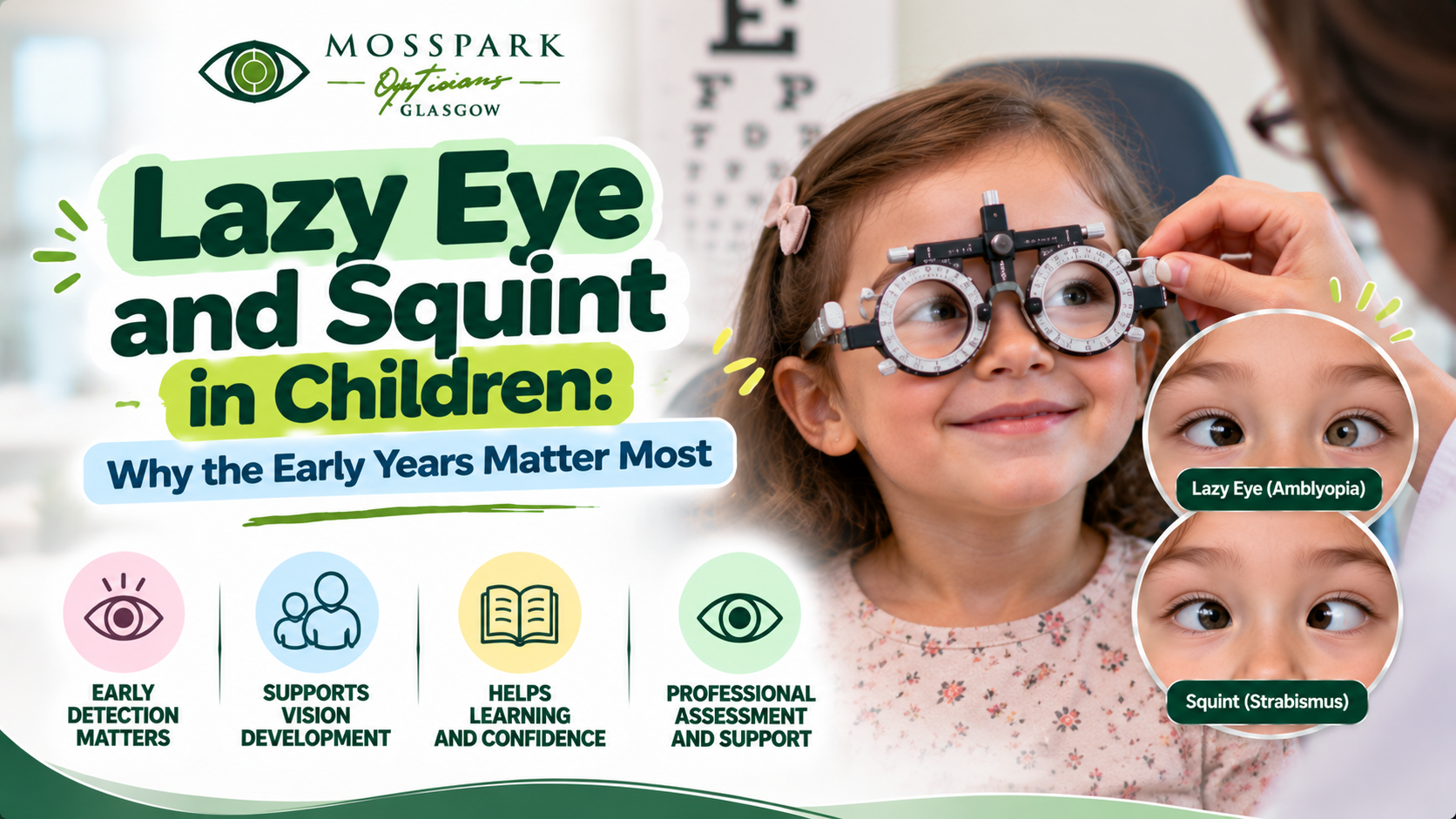
A lazy eye, or amblyopia, is an eye that has not developed normal vision in early childhood. The eye usually looks normal. The brain has learned to rely on the other eye, most often because of a squint or because one eye needs a stronger prescription than the other.
A squint is where the eyes point in different directions. A lazy eye is reduced vision in one eye. A squint is one of the main causes of a lazy eye, but many children have a lazy eye with no squint, and both eyes look perfectly straight.
Often you cannot tell, because a child with one good eye behaves normally. Possible signs are an eye that turns, closing or covering one eye, tilting the head, objecting when one particular eye is covered, or clumsiness. The reliable way to find out is an eye examination that tests each eye separately.
Treatment usually starts with glasses, worn full time, which improve the weaker eye in many children on their own. If more is needed, the stronger eye is covered with a patch for part of the day, or blurred with drops, so that the weaker eye has to work. This is managed by the hospital orthoptic service.
Treatment works best in early childhood, when the visual system is still developing, and becomes slower and less effective as a child gets older. It can still be worth trying in an older child, so it is always worth asking. The aim is to find it before school age.
Other Articles from Mosspark Opticians: