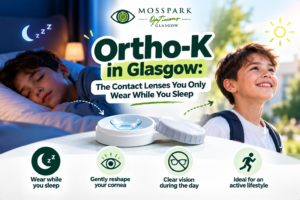

Most people have never heard of a contact lens you put in at bedtime and take out at breakfast. When I explain it, the usual reaction is a pause, followed by “and then I can just see?”
Yes. That is Ortho-K, short for orthokeratology. It is not new and it is not magic, but for the right person it solves problems that glasses and ordinary lenses do not. It is also one of the options I use to slow short sight in children, which is where most of the interest now comes from.
That is the macula telling you something, and it is worth knowing what, because one form of macular degeneration is slow and the other is not. Which one you have decides whether you book a routine appointment or pick up the phone today.
A child’s short sight usually increases as they grow, because the eye itself grows longer. Ordinary glasses correct the blur but do nothing about the growth. Myopia management is the name for treatments that try to slow it down, and Ortho-K is one of them.
The College of Optometrists has reviewed the evidence. Across studies lasting one to three years, Ortho-K slowed eye growth by somewhere between about 30 and 50 per cent compared with standard glasses or lenses. That is a worthwhile effect, because higher levels of short sight carry more risk of eye problems later in life.
I would rather you had the honest version than the brochure. The effect seems to be strongest in the first year or two and may reduce after that. There is some evidence that stopping can be followed by a faster spell of growth. And there is not yet much data beyond four years. None of that is a reason to avoid it. It is a reason to go in with clear expectations and regular reviews.
There is more background in myopia in children, and the full range of options is on the myopia management page.
I find out which side of the line you are on at the assessment, before you have committed to anything.
The same evidence review found that contact lens wear by children, Ortho-K included, is generally safe, with a risk similar to other lenses worn overnight. The risk that matters is infection, and it is almost always down to hygiene.
With children I involve a parent at every step. Most children manage the routine well once they have been taught properly, often better than their parents expect.
Ortho-K is one of several approaches. There are daytime soft lenses and spectacle lenses designed for myopia management too, and for an adult who simply wants comfortable vision, a modern daily disposable may be all that is needed. I have compared the everyday options in contact lenses in Glasgow: daily, monthly or Ortho-K, and fitting is explained on the contact lens page.
If this is for a child who has not had their eyes checked recently, start with a children’s eye test. Everything else follows from that.
Book your comprehensive eye examination or eyewear styling consultation with
Mosspark Opticians today.
Ortho-K, or orthokeratology, uses a rigid contact lens worn overnight to gently reshape the front surface of the eye. You remove the lenses in the morning and can see clearly through the day without glasses or contact lenses. The effect is temporary and wears off if you stop wearing the lenses.
It can. An evidence review by the College of Optometrists found that Ortho-K slowed eye growth by roughly 30 to 50 per cent over one to three years compared with standard correction. The effect may reduce over time, growth may speed up again after stopping, and there is limited evidence beyond four years.
The evidence indicates that contact lens wear by children, including Ortho-K, is generally safe, with a risk similar to other lenses worn overnight. The main risk is infection, which is closely tied to hygiene. Careful cleaning every night, never using tap water, and prompt attention to any red or sore eye keep that risk low.
No. The reshaping is temporary. If you stop wearing the lenses, your eyes return to their previous shape and prescription, usually within days to a couple of weeks. Clear daytime vision depends on wearing the lenses every night.
It works best for low to moderate short sight and has limits on how much astigmatism it can correct. It may not suit some corneal shapes, untreated dry eye, or anyone unlikely to keep to the nightly cleaning routine. Suitability is decided at an assessment that includes mapping the front surface of the eye.
Other Articles from Mosspark Opticians: