
The question we get asked is “which contact lenses are best”. It has no answer, in the same way that “which shoes are best” has no answer.
What there is instead is a fairly short set of questions about your eyes, your prescription and your life, and the answers narrow it down quickly. This article runs through them in the order we would, so you arrive at a contact lens fitting already knowing roughly where you are heading.
Lens type | Best suited to | What to weigh up |
|---|---|---|
Daily disposable | Most new wearers, part-time wear, sport, hay fever | Higher per-day cost, no cleaning routine at all |
Monthly / fortnightly | Full-time wearers, cost per month | Requires a proper cleaning routine every night |
Toric | Astigmatism | Slightly higher cost; fit matters more |
Multifocal | Over-40s wanting to drop reading glasses | Adaptation period; not everyone gets on with them |
Ortho-K (overnight) | Sport, dusty work, myopia management in children | Worn asleep; needs commitment to the routine |
Rigid gas permeable | Complex prescriptions, keratoconus | Longer adaptation; excellent optics once settled |
Coloured / cosmetic | Appearance change | Must still be professionally fitted, always |
If you take one thing from the table: daily disposables suit more people than any other option, and the reason is not optical. It is that there is no routine to forget.
Fresh lens every day, straight in the bin at night. No solutions, no case, no cleaning, and no accumulation of deposits on the lens surface.
The hygiene argument is the strong one. Most contact lens complications trace back to handling, storage or overwear rather than the lens itself, and dailies remove most of those opportunities. They are also the obvious answer for occasional wear, for hay fever season, and for anyone who wants lenses for sport but glasses the rest of the time.
The trade-off is cost per day of wear, which is higher. For someone wearing lenses two or three days a week, that trade-off usually favours dailies anyway.
Better value for full-time wear, and the range of available prescriptions and materials is broad. The condition attached is a genuine nightly routine: correct solution, proper rub-and-rinse, fresh solution each time, case replaced regularly.
Never top up old solution, never use water, and never sleep in a lens that is not designed for it. Those three account for a large share of the problems we see.
We hear this weekly, and it is very often out of date. Two reasons come up repeatedly.
Twenty years ago this genuinely limited the options. Now toric lenses handle most astigmatism routinely, including in daily disposables. If you were turned away in the past, it is worth asking again.
Often solvable rather than disqualifying. It may mean a different lens material, a different replacement schedule, a different solution, a shorter wearing day, or treating an underlying dry eye problem that was never addressed. Going from comfortable all-day wear to struggling by mid-afternoon is a reason to be assessed, not a reason to give up.
The option most people have never heard of, and the one that generates the most interest once explained.
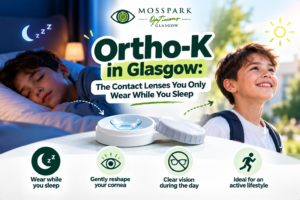
Orthokeratology uses a rigid lens worn overnight that gently reshapes the front surface of the eye. You take the lenses out in the morning and see clearly through the day with nothing on your eyes at all. The effect is temporary and reverses if you stop, so it requires consistency.
It suits three groups particularly well: people in dusty or dry environments where daytime lenses are uncomfortable, athletes in sports where lenses or glasses are a nuisance, and — importantly — children, because Ortho-K is one of the recognised approaches to myopia management. Where a child’s short sightedness is increasing year on year, slowing that progression matters more than simply correcting it, and starting earlier consistently produces more benefit.
If you have started holding menus at arm’s length, multifocal contact lenses are worth a conversation. They are not magic: there is an adaptation period, and a minority of people never fully get on with them. But for many, the alternative of reading glasses over contact lenses is worse.
Some people do better with a monovision approach instead. Which of those suits you is a fitting question rather than a preference, and it is exactly the sort of thing a trial pair answers. Our article on reading glasses after 40 covers the background.
Contact lenses solve several sporting problems at once: nothing to displace in a tackle, full peripheral field, and no frame between an elbow and the eye socket. They are frequently the right answer for contact sport, and we cover the discipline-by-discipline picture on our sports optician page.
The exception is water. Do not swim in contact lenses without proper precautions; the infection risk is real and avoidable, and prescription goggles are the better answer. There is more detail in our article on swimming and contact lens safety.
A contact lens fitting is not the same appointment as an eye test, and it is not a five-minute add-on.
If you are weighing lenses against glasses generally, our article on glasses or contact lenses sets out the comparison, and choosing contact lenses in Glasgow covers the practicalities.
A painful red eye in a contact lens wearer is treated as urgent, not routine. Take the lens out, do not put it back in, and ring us.
Book your comprehensive eye examination or eyewear styling consultation with
Mosspark Opticians today.
Daily disposables, in most cases. There is no cleaning routine to learn or forget, no storage case, and no build-up of deposits, which removes most of the situations where new wearers run into trouble. Cost per day is higher, but for anyone wearing lenses part-time that usually works out favourably anyway.
Yes. Toric lenses correct astigmatism and are widely available, including as daily disposables. If you were told years ago that you could not wear lenses because of astigmatism, that advice is very likely out of date and it is worth asking again.
Orthokeratology uses a rigid lens worn overnight that gently reshapes the front surface of the eye. You remove the lenses in the morning and see clearly through the day with nothing on your eyes. The effect is temporary and reverses if you stop wearing them, so it requires consistency. It is also one of the recognised approaches to myopia management in children.
It can be, and it is one of the options we discuss where a child’s short sightedness is increasing year on year. Slowing that progression matters more than simply correcting it, and starting earlier produces more benefit than starting later. Suitability depends on the individual child, their prescription and their ability to manage the routine.
Often yes, but it may require changes: a different lens material, a different replacement schedule, a different solution, a shorter wearing day, or treating an underlying dry eye problem that was never addressed. Going from comfortable all-day wear to struggling by mid-afternoon is worth investigating rather than giving up on lenses.
Not without proper precautions. Water carries a real infection risk for lens wearers, including organisms that cause serious corneal infection. Prescription swimming goggles are the better answer, and they also mean you can actually see the clock and the wall rather than guessing.
At the intervals agreed at your fitting, typically annually or more often depending on the lens and your eyes. Aftercare is a clinical requirement rather than a sales appointment: it checks the health of the eye surface, the fit of the lens and whether your prescription has changed.
Daily disposables, in most cases. There is no cleaning routine to learn or forget, no storage case, and no build-up of deposits, which removes most of the situations where new wearers run into trouble. Cost per day is higher, but for anyone wearing lenses part-time that usually works out favourably anyway.
Yes. Toric lenses correct astigmatism and are widely available, including as daily disposables. If you were told years ago that you could not wear lenses because of astigmatism, that advice is very likely out of date and it is worth asking again.
Orthokeratology uses a rigid lens worn overnight that gently reshapes the front surface of the eye. You remove the lenses in the morning and see clearly through the day with nothing on your eyes. The effect is temporary and reverses if you stop wearing them, so it requires consistency. It is also one of the recognised approaches to myopia management in children.
It can be, and it is one of the options we discuss where a child’s short sightedness is increasing year on year. Slowing that progression matters more than simply correcting it, and starting earlier produces more benefit than starting later. Suitability depends on the individual child, their prescription and their ability to manage the routine.
Often yes, but it may require changes: a different lens material, a different replacement schedule, a different solution, a shorter wearing day, or treating an underlying dry eye problem that was never addressed. Going from comfortable all-day wear to struggling by mid-afternoon is worth investigating rather than giving up on lenses.
Not without proper precautions. Water carries a real infection risk for lens wearers, including organisms that cause serious corneal infection. Prescription swimming goggles are the better answer, and they also mean you can actually see the clock and the wall rather than guessing.
Yes. They are different appointments doing different things. The eye examination establishes your prescription and checks eye health; the fitting measures the eye surface, assesses the tear film and trials an actual lens. Everything in the fitting depends on the examination being right first.
Other Articles from Mosspark Opticians: