

“I was told I couldn’t wear contact lenses” is something I hear a lot. Sometimes it was true at the time. More often it meant the ordinary soft lenses on the shelf did not suit, and nobody went any further.
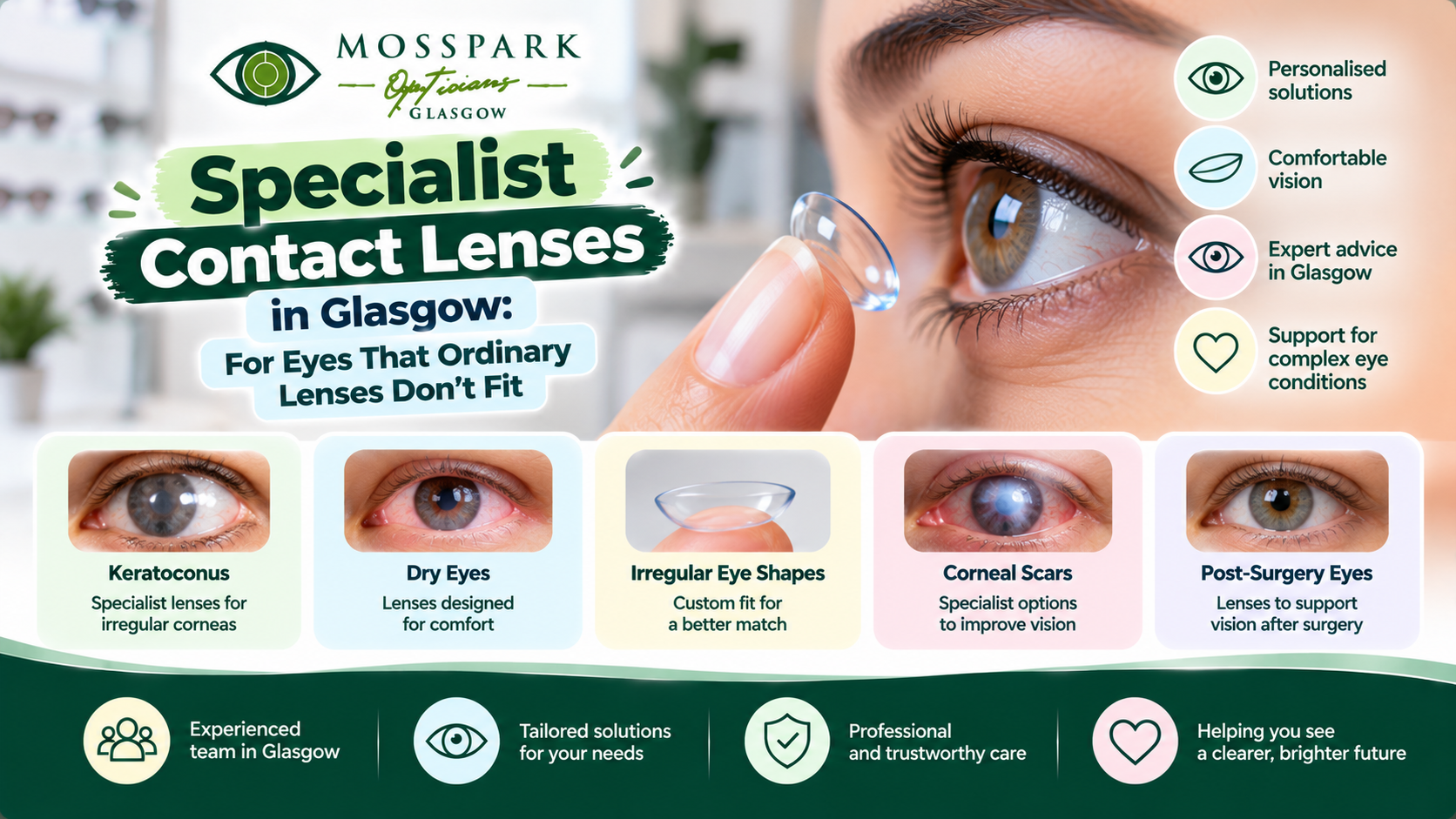
Specialist lenses are made for the eyes that standard lenses do not fit: irregular corneas, high or unusual prescriptions, eyes that have had surgery, and people who need clear vision at more than one distance. They take longer to fit, but for the right person they can give better vision than glasses ever did.
I visit care homes and sheltered housing on Glasgow’s Southside. This post is for the managers and staff who arrange those visits, and for families who want to know what their relative should be getting.
Keratoconus usually starts in the teens or twenties. The cornea, which should be smoothly curved, becomes thinner and more cone-shaped. Vision becomes distorted, and the prescription often changes quickly.
In the early stages glasses can still work well. As the cornea becomes more irregular, glasses cannot correct the distortion, because they sit away from the eye. A rigid lens sits on the eye and gives it a new, smooth front surface, which is why rigid and scleral lenses usually give much better vision at that stage.
If you have keratoconus, you should also be under the care of the hospital eye service, which can treat the cornea to help stop it changing. If your sight has been getting worse quickly, or you were diagnosed and have not been seen in a while, I can arrange a referral, including a private referral if you want to be seen sooner.
Small, firm lenses that let oxygen through. They give very sharp vision, particularly for irregular corneas and astigmatism, and they last much longer than soft lenses. They take a week or two to get used to.
Larger rigid lenses that vault over the cornea and rest on the white of the eye, with a layer of fluid underneath. Many people find them more comfortable than smaller rigid lenses, and they suit irregular corneas and some very dry eyes.
Soft lenses designed for astigmatism, shaped to stay the right way round on the eye. Standard ranges cover most prescriptions, and made-to-order versions extend that a long way. There is more in astigmatism explained.
Soft or rigid lenses with zones for distance and near, for people over 40 who would rather not reach for reading glasses.
Rigid lenses worn overnight to reshape the cornea temporarily, so you can see clearly through the day with no lenses in. Explained in full in Ortho-K in Glasgow.
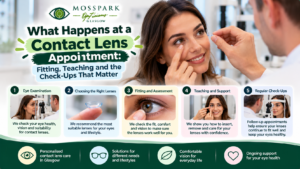
How a standard fitting works is explained in contact lenses in Glasgow: daily, monthly or Ortho-K, and more on how we work is on our contact lens page.
If you have given up on contact lenses, or you wear them but they blur, move or ache by the afternoon, it is worth a fresh look. The common causes are covered in how to stop blurry vision while wearing contact lenses. Dryness is often treatable on its own, as I have explained on our dry eye and blepharitis page.
Book your comprehensive eye examination or eyewear styling consultation with
Mosspark Opticians today.
Specialist contact lenses are designed for eyes that standard soft lenses do not suit, including keratoconus, high or irregular astigmatism, very high prescriptions, irregular corneas after surgery or injury, and people who need multifocal correction. They include rigid gas permeable, scleral, custom toric, multifocal and Ortho-K lenses.
Rigid gas permeable and scleral lenses usually give the best vision for keratoconus, because they create a smooth front surface over the irregular cornea. Other designs suit some people. The right lens depends on how advanced the condition is and the shape of the cornea.
Yes. Toric soft lenses correct most levels of astigmatism, and made-to-order toric or rigid lenses can correct higher and irregular astigmatism. Many people who were once told they could not wear lenses because of astigmatism can wear them now.
Many people find scleral lenses more comfortable than smaller rigid lenses, because they rest on the white of the eye rather than the sensitive cornea and hold a layer of fluid over the eye. They take some practice to put in and take out at first.
Specialist fittings usually take more than one appointment. Lenses are often made to order from measurements of the eye, and the design may be adjusted after trial wear before the final lenses are supplied.
Other Articles from Mosspark Opticians: