
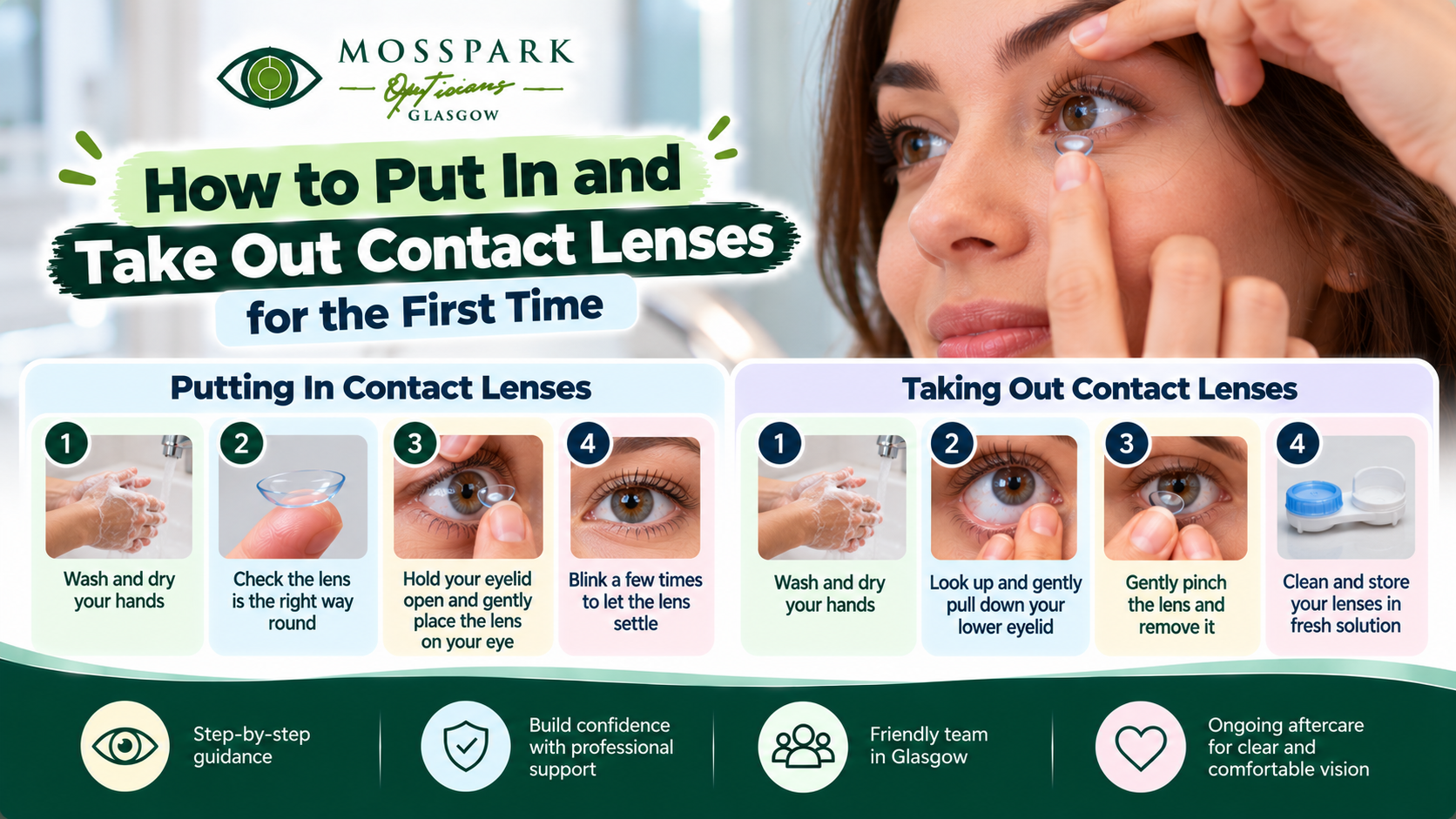


Almost everyone who tries contact lenses for the first time says the same thing: “I can’t touch my eye.” Your eye does not want you to either. The blink reflex is one of the fastest in the body, and the first few attempts can feel like a wrestling match.
Then, usually within one appointment, it clicks. I have taught people from eight to eighty, and very few go home unable to do it. This is the method I teach, written down so you can practise at home.
A soft lens can turn inside out, and an inside-out lens feels uncomfortable and moves about. Balance the lens on your fingertip and look at it from the side.
For some people, contact lenses are the simplest answer for sport in winter. They cannot fog. If you have never tried them, glasses or contact lenses: how to decide sets out the trade-offs.
Most people manage within the teaching session at their fitting, and nobody leaves us until they can put lenses in and take them out on their own. It gets faster with every attempt, and within a week or two most people do it without thinking. What happens at that appointment is set out in what happens at a contact lens appointment.
If you are still choosing between lens types, daily lenses are the simplest for beginners because there is no cleaning. I have compared the options in daily, monthly or annual: how to choose the right contact lenses. Rigid lenses are handled differently, and I have explained those in specialist contact lenses in Glasgow.
If your vision looks misty even after the lenses have cleared, or one eye looks hazier than the other, the problem may not be your glasses. Scratched lenses, a prescription that has changed, or a cataract can all make the world look as if it is behind a steamed-up window. If wiping your lenses does not fix it, book an eye examination and we will find out which it is.
A little watering in the first few days is normal. Pain, redness that gets worse, blurred vision that does not clear when you blink, or eyes that are sensitive to light are not. Take the lenses out and ring us the same day, or see our guide to emergency eye care in Glasgow. If your vision with lenses is simply not as sharp as it should be, how to stop blurry vision while wearing contact lenses covers the usual causes.
Book your comprehensive eye examination or eyewear styling consultation with
Mosspark Opticians today.
No. A correctly fitted soft lens should not hurt going in or once it is in place. You may feel it for a few seconds, and your eyes may water a little in the first few days. If a lens is painful, take it out and check that it is clean, undamaged and the right way round.
Balance the lens on your fingertip and look at it from the side. The right way round, it forms a bowl with the edge pointing straight up. Inside out, the edge flares outwards like a saucer. Some lenses also have small markings that read correctly when the lens is the right way round.
No. A thin membrane covering the white of the eye and the inside of the eyelids stops anything getting behind the eye. A lens that seems to have disappeared has usually moved under the upper eyelid or fallen out.
Most people learn during the teaching session at their contact lens fitting. It may take several attempts at first, but it becomes quick and routine within a week or two of daily practice.
Wash your hands, look up and slide the lens down onto the white of the eye before pinching it out. If the lens feels stuck, put in a few drops of contact lens solution or rewetting drops, wait a minute and try again. If you still cannot remove it, contact your optometrist.
Other Articles from Mosspark Opticians:


Holiday Closure
We’ll be closed from 26th October to 9th November, reopening on 10th November.
Thank you for your understanding!
Team Mosspark Opticians