

You step off a cold bus into a warm shop and, for about thirty seconds, you cannot see a thing. Every glasses wearer in Glasgow knows the feeling, and from now until March it happens several times a day.
It is mostly harmless and mostly annoying. But it is also preventable, and some of the fixes people try do more damage to their lenses than the fog ever could.
This is the companion to my guide on the best glasses for round faces, which is one of the most read things on our site. The principle is the same, just in reverse.
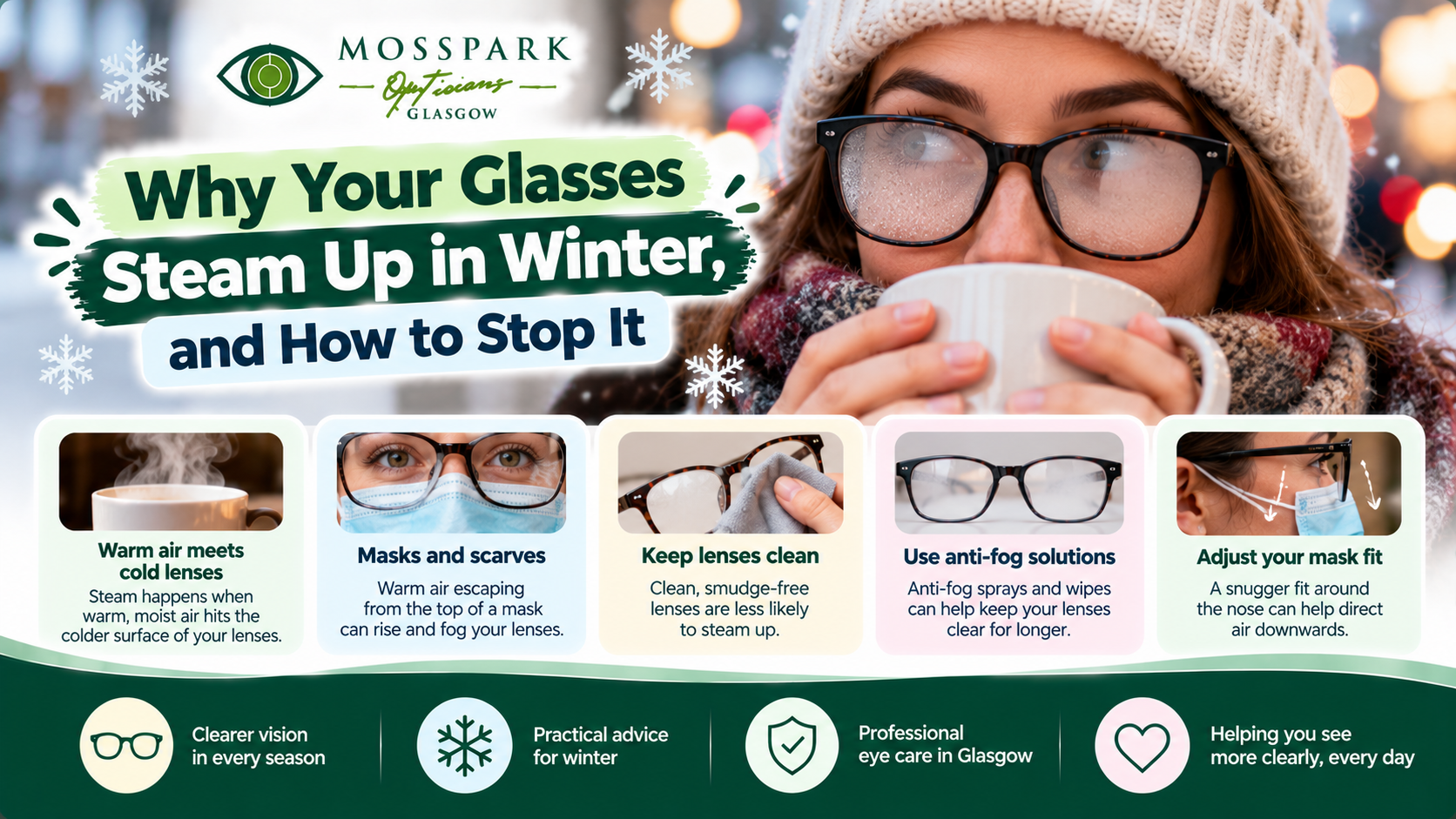
Warm air holds more moisture than cold air. When warm, damp air touches a surface that is colder than it, the moisture condenses into tiny droplets. That is why a cold can of juice gets wet on the outside, and it is exactly what happens to your lenses.
Glasgow is almost designed for it: cold, damp air outside and warm, heated rooms inside.
Car heaters set to blow at your face will fog your glasses as soon as you get in from the cold, and that is the one place it is dangerous. Set the vents to the windscreen, let the car warm up before you set off, and if your glasses fog while you are driving, pull over when it is safe and wait for them to clear.
Winter brings other driving problems too, from headlight glare to dirty windscreens. I have covered those in night driving and winter glare.
Exercise is the hardest situation, because the fog comes from your own warm face as well as the air. A sports frame that sits slightly further from the face with some ventilation helps a lot, as does an anti-fog treatment on the inside of the lens. I have written about this for runners in prescription running glasses, and the options for other sports are in my sports eyewear discipline guide.
For some people, contact lenses are the simplest answer for sport in winter. They cannot fog. If you have never tried them, glasses or contact lenses: how to decide sets out the trade-offs.
If you wear lenses that darken in sunlight, you may notice they behave differently in winter. Photochromic lenses tend to go darker in the cold and take longer to clear when you come back indoors. That is normal, not a fault. There is more on how they work in photochromic lenses vs sunglasses.
If your vision looks misty even after the lenses have cleared, or one eye looks hazier than the other, the problem may not be your glasses. Scratched lenses, a prescription that has changed, or a cataract can all make the world look as if it is behind a steamed-up window. If wiping your lenses does not fix it, book an eye examination and we will find out which it is.
Book your comprehensive eye examination or eyewear styling consultation with
Mosspark Opticians today.
Your lenses are still cold from outdoors, and when warm, moist indoor air touches them, the moisture condenses into tiny droplets on the surface. The fog clears on its own as the lenses warm up to room temperature.
Stop your breath travelling upward. Pull the scarf or face covering up over the bridge of your nose and rest your glasses on top of it, or use one with a nose wire pinched to fit. An anti-fog coating or spray also helps.
Yes, anti-fog coatings and treatments reduce fogging noticeably. Some are built into the lens coating, and others are topped up with a special cloth or spray. They are worth asking about if fogging bothers you every day.
Washing lenses with a small amount of mild washing-up liquid in lukewarm water leaves a thin film that reduces fogging for a while. Rinse lightly and let them dry or pat them dry with a clean cloth. It is also a safe way to clean most lenses.
No. Toothpaste is abrasive and can scratch lenses, and shaving foam and household cleaners can damage lens coatings. Use a mild soap and water wash or an anti-fog product made for coated spectacle lenses.
Other Articles from Mosspark Opticians:


Holiday Closure
We’ll be closed from 26th October to 9th November, reopening on 10th November.
Thank you for your understanding!
Team Mosspark Opticians