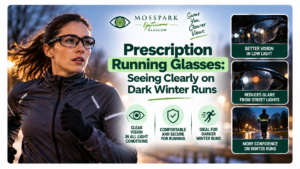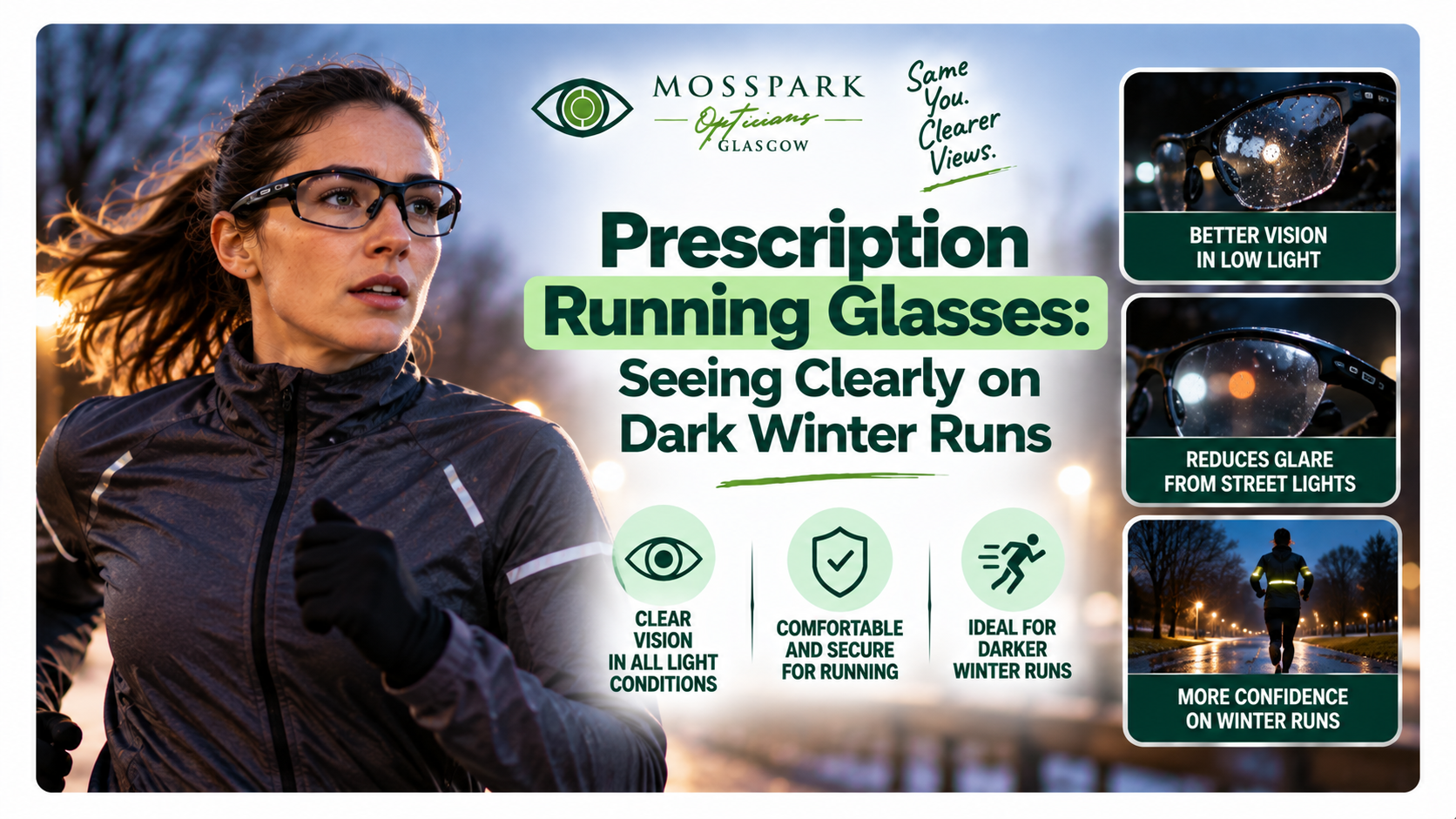


From late October, most Glasgow runners are training in the dark for at least part of the week. Add rain, low winter sun and headlights reflecting off wet roads, and seeing clearly becomes a real challenge. Prescription running glasses built for these conditions make a noticeable difference, both to comfort and to safety.
Whether you run laps of Bellahouston Park or head out towards Pollok Country Park, here is what to look for.
Everyday frames are designed to sit still on a face that is sitting still. When you run, they bounce and slip as you sweat. Flat lenses leave gaps at the sides for wind and rain, they steam up when you stop at a crossing, and most everyday frames are not made to take a fall.
A fit that stays put
Look for lightweight frames with grippy nose pads and temple tips that hold without pinching. If a frame moves when you shake your head in the practice, it will move a great deal more at the end of a 10k.
Wraparound frames made accurately
Wraparound frames protect your eyes from wind, rain and grit. Putting a prescription into a curved lens needs careful compensation, otherwise your vision can feel slightly off. This is specialist work, and very strong prescriptions may limit how much wrap is possible. We will tell you what is realistic for your prescription.
Light, impact-resistant lenses
Polycarbonate and Trivex lenses are lighter than standard materials and far more impact resistant, which matters if you trip on a dark path
Avoid dark tints once the light starts to fade. They reduce what you can see just when you need it most.
Wear reflective or high-visibility kit, angle a head torch slightly downwards so it lights the ground without dazzling others, and choose well-lit routes where you can. Let someone know your route if you are running alone after dark.
Many runners prefer daily disposable contact lenses. There is nothing to bounce, fog or slip, and your side vision is unrestricted. Pairing them with non-prescription wraparound glasses protects your eyes from wind and rain. Cold wind can make lenses feel dry, so blink regularly and carry rewetting drops on longer runs.
On clear winter days, the sun sits low for hours and reflects off wet roads. For daytime runs, polarised lenses cut that reflected glare effectively. A cap with a peak also helps. Neither is suitable once it is getting dark.
Bring any running kit that affects fit, such as a cap or head torch, to your appointment. Check your prescription is up to date first, since running glasses made to an old prescription waste much of their benefit. Our guide to prescription cycling glasses covers similar ground for riders, and you can read more about prescription sports glasses in Glasgow or about us as an independent optician in Glasgow.
To be fitted for prescription running glasses, call us on 0141 427 4040.
Book your comprehensive eye examination or eyewear styling consultation with
Mosspark Opticians today.
Yes. Many sports frames, including wraparound styles, can be made with your prescription, and some use a prescription insert behind a sports lens
Clear lenses with an anti-reflection coating are best in the dark. Yellow or amber lenses can help at dusk and in fog. Avoid dark tints once the light fades.
Choose well-ventilated frames that sit slightly away from your face, and ask for an anti-fog coating. Fogging is usually worst when you stop moving.
Many runners prefer daily contact lenses because there is nothing to bounce or fog. Wearing non-prescription wraparound glasses over them protects against wind and rain.
Often yes, although very strong prescriptions may limit how curved the frame can be. An optician can advise on what will give you clear, comfortable vision.
Other Articles from Mosspark Opticians: