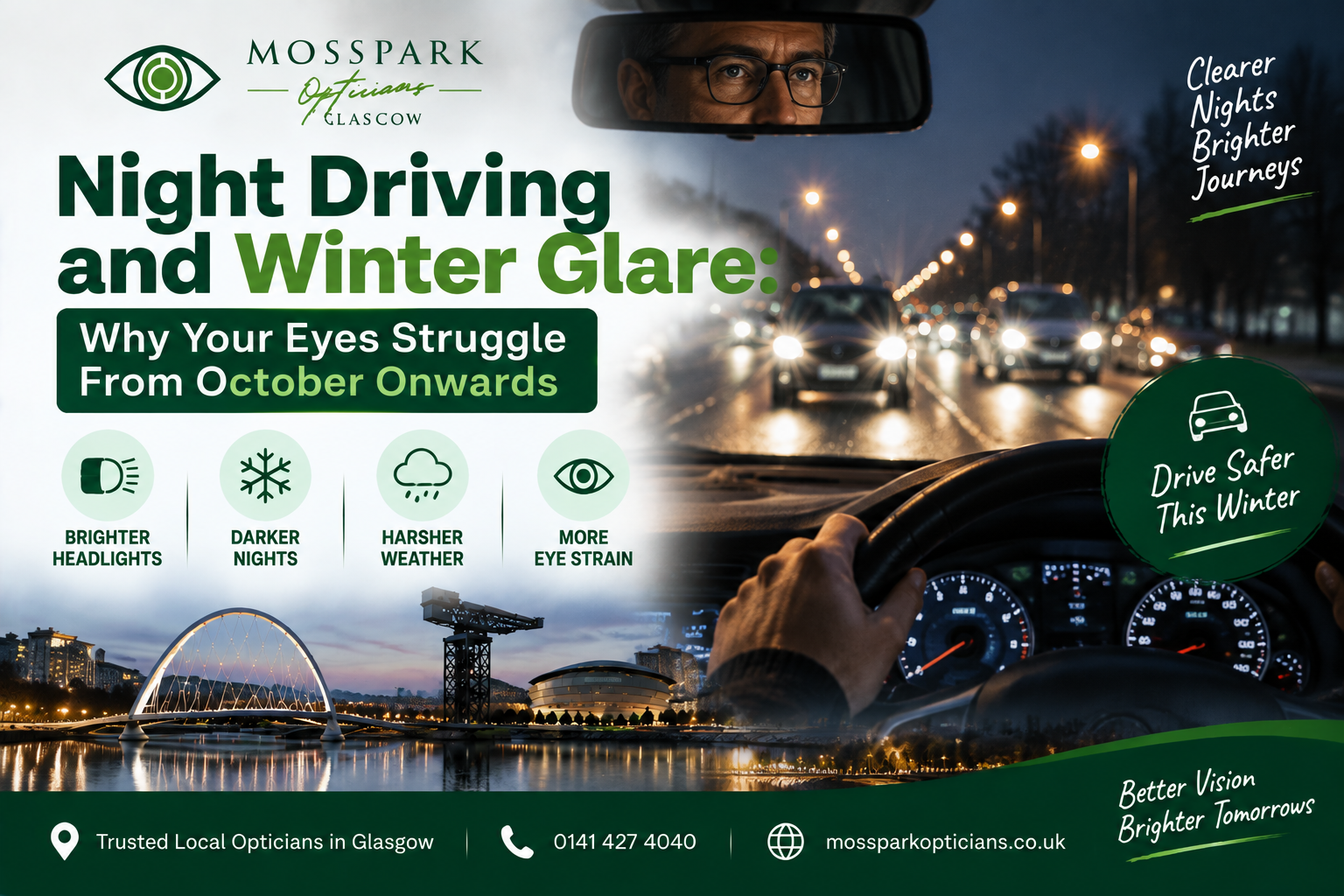

Every year, from about the first week of October, the same conversation starts happening in the practice. Somebody mentions, almost in passing, that they have started avoiding driving at night. Not because of anything dramatic. The headlights just seem harsher than they used to, the road markings are harder to pick out, and it has become tiring rather than routine.
It is one of the most common reasons people finally book an overdue eye test, and it is worth understanding, because some of what is happening is normal ageing, some of it is correctable in an afternoon, and a small part of it is genuinely not your eyes at all.
Even with perfect eyes, night driving asks more of the visual system than daylight does.
In low light your pupil opens wider to let more light in. A wider pupil means light passes through more of the lens and cornea, including the peripheral parts, and any small optical imperfection that is irrelevant in daylight starts to matter. That is why a prescription that feels perfectly adequate by day can feel inadequate at night.
Contrast also collapses. Judging the edge of a wet road, a dark-clothed pedestrian or an unlit cyclist is a contrast task, and contrast sensitivity declines gradually with age in a way that acuity does not. Two people can read the same line on a chart and have meaningfully different night driving experiences.
Worth understanding, because it explains where the risk comes from.
The new lenses are cut and edged to match the shape of your frame, then fitted. For a plastic frame, that means heating it until it flexes enough to accept the lens, and heating is the moment of danger. Acetate dries out over years; an older frame can become brittle without looking any different from the outside. It goes into the heat looking fine and comes out with a hairline crack.
For rimless frames the lenses are drilled and mounted directly, which means new holes in new lenses and reusing mounting hardware that has already been through this once. For semi-rimless, a groove is cut around the lens edge to take a nylon cord, and that groove has to be exactly right.
No optician can guarantee an old frame against breakage during reglazing. Anyone who does is either not being straight with you or is quietly pricing the risk into the job. We will tell you our honest assessment before starting, and it is your decision from there.
What you notice | Most likely cause | What helps |
|---|---|---|
Starbursts or streaks from headlights | Uncorrected astigmatism | Accurate prescription; AR coating |
Haloes around lights, worsening slowly | Early cataract | Assessment; referral if appropriate |
General dimness, needing more light to read | Pupil size and lens changes with age | Current prescription; good cabin lighting habits |
Ghosting or double edges on lights | Astigmatism or lens surface reflections | AR coating; check prescription |
Glare worse in rain | Wet road reflections plus any of the above | Clean windscreen; AR coating; correct prescription |
Dry, gritty eyes on long drives | Car heater drying the tear film | Redirect vents; treat dry eye |
Sudden change over days or weeks | Not routine | Book an appointment promptly |
The top row covers most of what we see. Small amounts of astigmatism cause disproportionate trouble at night, because the wider pupil exposes the optical error that daylight was hiding.
If headlights look like starbursts, streaks or crosses rather than points of light, astigmatism is the first thing to check.
Astigmatism means the eye’s surface is shaped slightly more like a rugby ball than a football, so light focuses unevenly. In daylight, with a small pupil, the brain compensates and you may notice nothing at all. At night, with the pupil wide open, that uneven focus turns every bright point into a smear.
The reason this is worth knowing: it is often a very small correction, it makes a disproportionate difference at night, and plenty of people have been driving for years without it because their daytime vision seemed fine. If you want to understand what appears on your prescription, understanding your glasses prescription breaks it down.
Modern headlights genuinely are different. LED and HID units produce a whiter, more concentrated light with a sharper cut-off than the older halogen lamps most of us learned to drive with. Vehicles also sit higher than they used to, which puts more oncoming beams closer to eye level.
So when someone says headlights seem harsher than they were twenty years ago, that is not purely an ageing effect. It does mean the visual system has less margin to spare, which is why correcting whatever is correctable matters more than it once did.
One product worth being blunt about.
Yellow-tinted “night driving glasses” are widely sold and the evidence does not support them. A tinted lens reduces the amount of light reaching your eye, and at night the problem is that there is not enough light to begin with. They may make headlights feel subjectively less harsh while actually reducing your ability to see a dark object at the roadside, which is the opposite of what you want.
What helps with glare is not a tint. It is an accurate prescription and a good anti-reflective coating. Related: polarised lenses are excellent in daylight and should never be worn for night driving, for the same reason — they cut light transmission. We cover the daylight case for them in polarised vs non-polarised sunglasses, and the photochromic question in photochromic lenses vs sunglasses.
Worth a specific note. Night driving in varifocals can feel different from daytime, because the wider pupil makes the peripheral distortion in the lens more noticeable, and because looking at mirrors involves using parts of the lens you rarely think about by day.
This is usually a lens design or fitting issue rather than a reason to abandon varifocals. A premium design with a wider corridor, correctly measured, is often noticeably better at night. There is more in our article on varifocals and readers.
The legal side is worth a line. You must be able to meet the eyesight standard for driving, and that is a continuing obligation rather than something checked once when you passed your test. If you are unsure whether you still meet it, an eye examination is the way to find out.
A full forty-minute examination with OCT imaging. For night driving specifically, we will pay particular attention to small amounts of astigmatism, to the clarity of the lens inside the eye, to your tear film, and to what you are actually experiencing rather than just what you can read on a chart.
Tell us at the start that night driving is the reason you came. It genuinely changes where we concentrate.
Book your comprehensive eye examination or eyewear styling consultation with
Mosspark Opticians today.
Most commonly uncorrected astigmatism. The eye’s surface is shaped slightly unevenly, so light focuses imperfectly. In daylight your pupil is small and the brain compensates, so you may notice nothing. At night the pupil widens, exposing that uneven focus, and every bright point of light smears into a star or streak. It is often a small correction that makes a large difference.
Several things change gradually with age: the pupil does not open as wide, the lens inside the eye becomes less clear, and contrast sensitivity declines. Add an uncorrected prescription or early cataract and the effect compounds. Gradual change over years is common; sudden change over days or weeks is not, and should be assessed promptly.
The yellow-tinted glasses sold for night driving are not supported by the evidence. Any tint reduces the light reaching your eye, and at night the problem is already too little light. They may make headlights feel subjectively softer while reducing your ability to see a dark object at the roadside. An accurate prescription and anti-reflective coating are what actually help.
Yes, genuinely. At night, light striking a lens reflects off both its surfaces, creating ghost images and reducing contrast. Anti-reflective coating cuts those reflections substantially. If you drive at night and your lenses are uncoated, it is the single best value improvement available to you.
Yes, and night driving is very often where cataract is first noticed, usually as haloes around lights and increasing glare, before daytime vision changes much. Cataract is common with age, develops slowly, is not an emergency and is treatable. The important thing is knowing that is what you are dealing with rather than quietly adapting around it.
Partly, yes. LED and HID headlights produce a whiter, more concentrated light with a sharper cut-off than older halogen units, and vehicles sit higher than they used to, putting more beams closer to eye level. So it is not purely an ageing effect, though it does mean your eyes have less margin to spare.
No. Polarised lenses are excellent in daylight for cutting glare off wet roads, but they reduce overall light transmission, which is the opposite of what you need after dark. The same applies to any tinted lens. Keep polarised for daytime and use a clear lens with anti-reflective coating at night.
Other Articles from Mosspark Opticians: