

You look at a clear sky and notice something drifting across your vision – a dark speck, a cobweb, a translucent worm-like shape that moves when you try to look at it directly. That’s a floater. Most of the time, it’s been there for a while and you’ve just noticed it. Occasionally, it’s something that needs urgent attention. Here’s how to tell the difference.
The inside of your eye is filled with a clear, gel-like substance called the vitreous humour. Over time – and especially after your 40s and 50s – this gel gradually liquefies and shrinks. As it does, tiny fibres within it clump together and cast shadows on the retina. Those shadows are the floaters you see. They’re physically real, inside your eye, and they move because the gel they’re floating in moves when your eye does.
Most floaters are harmless. They’re annoying, sometimes distracting, but they don’t damage your vision and they don’t indicate disease. Your brain eventually learns to ignore them, and most people stop noticing them after a few weeks.
Flashes are different from floaters and need more attention. They happen when the vitreous pulls on or tugs at the retina as it shrinks, stimulating the retinal cells and creating a brief sensation of light – usually in the peripheral vision, often described as a quick streak or a camera-flash effect. Occasional, isolated flashes in someone over 50 are common and usually part of normal vitreous ageing. But new, frequent, or persistent flashes are a warning sign that the vitreous is pulling on the retina hard enough to risk tearing it.
The pattern that needs urgent attention A sudden increase in floaters, new flashes of light, or a shadow or curtain effect across part of your vision – especially if all three appear together – warrants an urgent same-day examination. This combination can indicate a retinal tear or detachment, which is a genuine emergency. |
Probably harmless:
Needs urgent assessment:
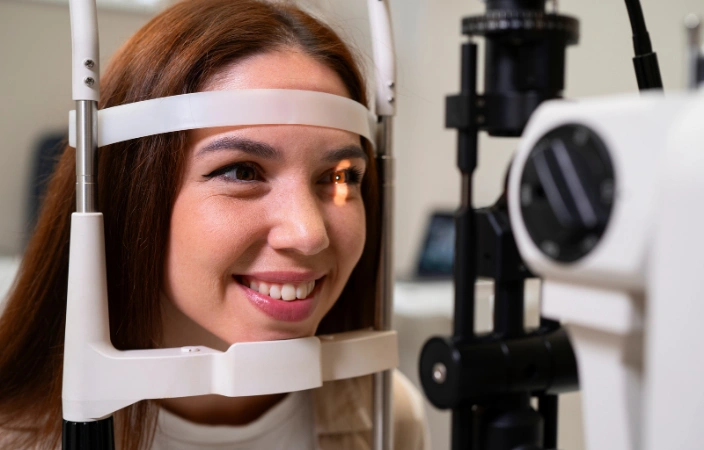
If you call us with sudden new floaters or flashes, we’ll prioritise you for a same-day dilated eye examination. We use drops to widen the pupil, which gives us a full view of the peripheral retina – the area most at risk of a tear. Our OCT retinal scanner adds a cross-sectional view of the retinal layers, which helps detect subtle changes that examination alone might miss.
If everything looks normal, you leave reassured. If we find a tear or anything suspicious, we’ll arrange a same-day referral to the hospital eye service for treatment – no waiting for a GP in between.
In most people over 50 who suddenly notice floaters or flashes, the cause is a posterior vitreous detachment – the vitreous gel peeling away from the retina as it shrinks. It sounds alarming, but it’s a normal ageing process that happens to most people eventually. The risk is that as it peels away, it can catch the retina and tear it – which is why the initial check matters, even though the PVD itself is harmless.
In most cases, no treatment is needed – the brain adapts and stops noticing them. For severe, persistent floaters that genuinely affect daily vision, laser vitreolysis or vitrectomy surgery exist as options, but these are specialist interventions with their own risks and are only considered when floaters are significantly disabling. We’ll always be honest about whether treatment is worth pursuing versus living with them.
If your floaters are longstanding and stable, your next routine eye examination is the right time to mention them. If something has changed suddenly – new floaters, new flashes, a shadow across your vision – call us now on 0141 427 4040. As an independent optician practice in Glasgow, we can see you the same day for urgent retinal assessments and refer directly if needed.
Book your comprehensive eye examination or eyewear styling consultation with
Mosspark Opticians today.
Most floaters are harmless clumps of protein in the vitreous gel. They become a concern when they appear suddenly, increase dramatically in number, or are accompanied by flashes of light or a shadow across your vision.
Flashes occur when the vitreous gel tugs on the retina as it shrinks with age. Occasional flashes are common, but new or frequent flashes should be assessed urgently to rule out a retinal tear.
An optician with the right equipment can perform a full dilated retinal examination and OCT scan, often faster than A&E. Call your optician first - if we find something that needs surgical intervention, we'll refer you to the hospital eye service directly.
A PVD is when the vitreous gel peels away from the retina as it naturally shrinks with age. It's common, usually harmless, but needs checking because the peeling process can occasionally tear the retina.
They rarely disappear entirely, but the brain adapts and most people stop noticing them within a few weeks. Treatment is only considered when they significantly affect daily vision.
Other Articles from Mosspark Opticians: