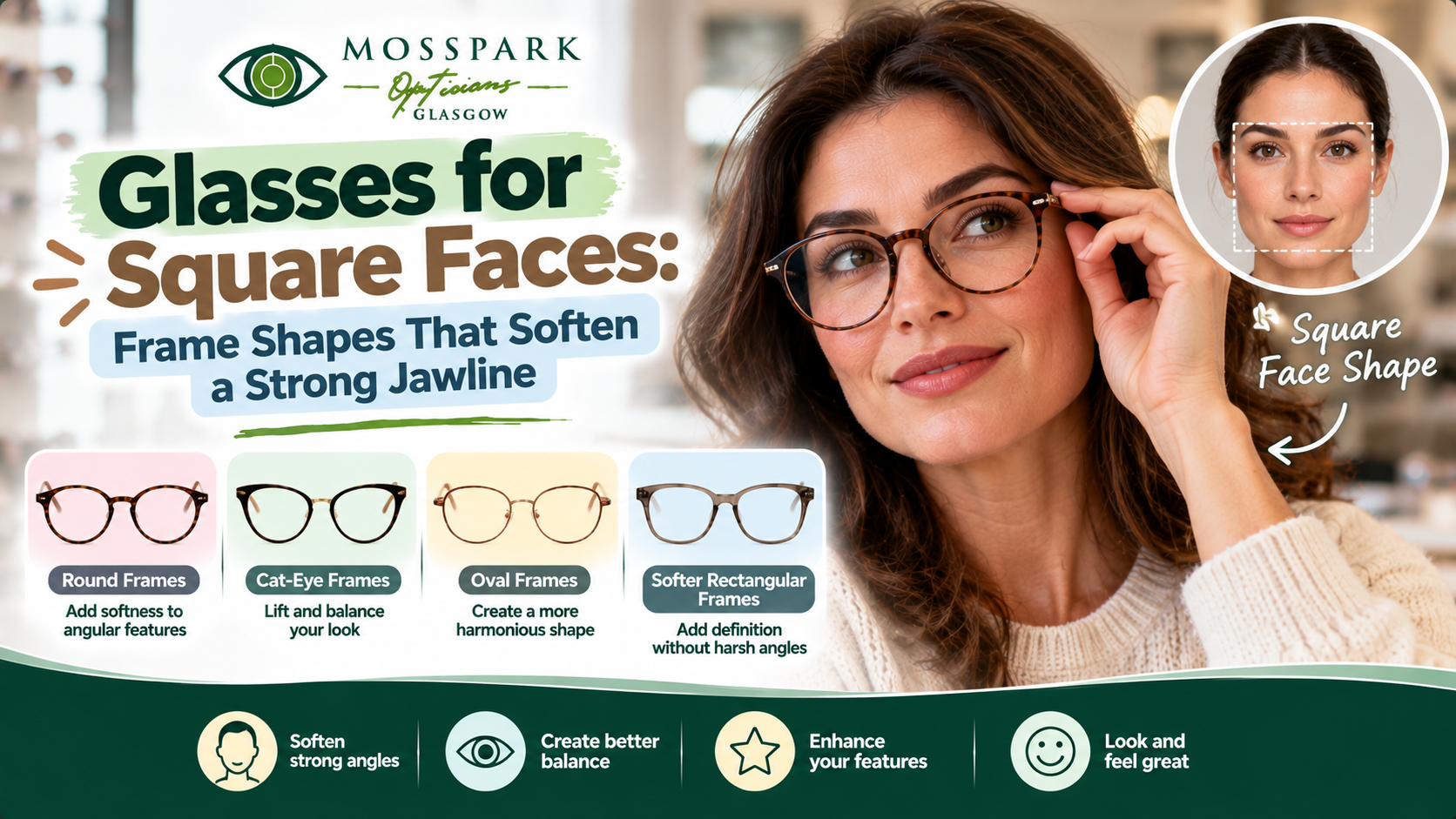


A square face is one of the easiest to dress with glasses once you know what you are working with. The strong lines that define it are an asset. The aim is not to hide them but to balance them, so that the frame and your features are not competing.
This is the companion to my guide on the best glasses for round faces, which is one of the most read things on our site. The principle is the same, just in reverse.
Pull your hair back, stand in front of a mirror and look straight ahead. A square face usually has:
If your face is clearly longer than it is wide but still angular, you are closer to rectangular. Most of this advice still applies, with slightly deeper frames. If your jaw is noticeably narrower than your forehead, you are closer to heart-shaped.
Frames either repeat the lines of your face or contrast with them. A boxy frame on a square face adds more straight lines to a face that already has plenty, and the result can look heavy. A frame with curves softens those lines and draws attention to your eyes rather than your jaw.
The clearest contrast. A round frame softens angles straight away. Choose one wide enough for your face, because small round frames on a broad face look out of scale.
If round feels like too big a change, a rectangle with well-rounded corners keeps a familiar shape but loses the hard edges.
A frame that lifts at the outer corners draws the eye upward and away from the jaw.
A heavier top edge with a fine or rimless lower half puts the weight high on the face. Choose one with a curved lower edge.
The teardrop lower edge is a natural counterweight to a square jaw, and they work for men and women alike.
If you would rather your glasses recede than make a statement, rimless or thin metal frames add very few lines at all.
Round and smaller frames are good news here, because a smaller, rounder lens is thinner at the edge. If your prescription is on the stronger side, read thin lenses for strong prescriptions before you choose, and see the options on our lenses page. If you are moving into varifocals, the frame also needs enough depth for the reading area, which I have explained in my varifocal lenses guide.
Face-shape charts only get you so far. The quickest way is to try a range of shapes with someone who will tell you plainly what they see. Our frame collection and the brands we stock cover everything above, and if you want an unhurried second opinion, book a free styling consultation.
If you are investing in a designer pair, it is worth reading designer glasses: how to choose frames that last as well, because the material and the hinges matter as much as the shape.
Book your comprehensive eye examination or eyewear styling consultation with
Mosspark Opticians today.
Round, oval, soft-cornered rectangle, cat-eye, browline and aviator frames tend to suit square faces, because their curves balance a strong, angular jaw. The frame should be about as wide as the face at the temples, with the eyes near the centre of each lens.
Square frames add more straight lines to an already angular face, so they can look heavy. They are not off limits, though. If you want a bold look, choose a square frame with slightly rounded corners and a slimmer rim.
A square face has a forehead, cheekbones and jaw of similar width, a strong angular jawline, and a length roughly equal to its width. Pull your hair back and trace the outline of your face in a mirror to see the shape clearly.
Tortoiseshell, warm browns, clear frames and warm metals such as gold or bronze soften angular features. Black and other dark colours work well too, ideally in a rounded shape so the frame does not exaggerate the angles of the face.
Yes. Round and softly rounded shapes are among the best choices for men with square faces, because they soften a strong jaw. Choose a frame wide enough for your face, as small round frames look out of proportion on a broad face.
Other Articles from Mosspark Opticians: