

Polarised sunglasses cut glare reflected off flat surfaces such as wet roads, water and car bonnets. Non-polarised sunglasses reduce overall brightness but not reflected glare. Neither protects your eyes from UV unless the lenses are made to block it, so check for UV400 whatever you choose.
I’m Rahillah Moghul, the Independent Prescribing optometrist who owns Mosspark Opticians in Bellahouston. Patients often ask me whether polarised lenses are worth the extra cost. In Glasgow, with low winter sun on wet roads, they often are. But they aren’t the best choice for everyone. This guide explains the difference, the downsides people don’t mention, and how to choose.
When sunlight bounces off a flat surface, such as a wet road, a lake or a car windscreen, the reflected light becomes concentrated in one direction. That is the harsh glare that makes you squint.
Polarised lenses contain a filter that blocks this reflected light while letting the rest through. The result is less glare, more comfortable eyes and better contrast, so you can see through the surface of water or the shine on a wet road more clearly.
Non-polarised sunglasses have a tint that reduces the overall amount of light reaching your eyes. They make bright days more comfortable, but they dim everything evenly, so strong reflections are darker but still there.
Good non-polarised sunglasses still give full UV protection. They are often cheaper, and they don’t interfere with phone or car screens.
Polarised | Non-polarised | |
Reduces overall brightness | Yes | Yes |
Cuts reflected glare | Yes | No |
UV protection | Only if labelled UV400 | Only if labelled UV400 |
Phone and dashboard screens | Can look dark or patchy | Clear |
Best for | Driving in daylight, water, snow, golf, cycling | Everyday wear, screens, flying |
Price | Usually higher | Usually lower |
Polarised lenses are excellent for glare, but they have some downsides:
If you spend most of your time in town, using your phone, non-polarised sunglasses with full UV protection may suit you better.
In Glasgow, the sun is low in the sky for much of the year, and the roads are often wet. That combination produces some of the worst glare drivers face, especially on autumn and winter mornings and evenings. Polarised lenses cut that reflected glare and make driving much more comfortable.
A few rules to know:
You also need to meet the legal eyesight standard to drive, with your glasses or contact lenses if you wear them. Here’s the eyesight standard for driving.
If you’re still not sure, bring them in. We can check your sunglasses in the practice.
If you wear glasses, you don’t have to choose between seeing clearly and cutting glare. Polarised lenses are available in most prescriptions, including varifocals, so you can read a map and see the road in one pair. Our guide to prescription sunglasses in Glasgow explains the options.
There are other ways to combine sun protection with your prescription:
You can see the lens options on our advanced lenses page, and browse our independent and designer frames. If you need a new prescription first, book a 45-minute eye examination.
Choose polarised if you drive a lot in daylight, fish, sail, cycle, play golf or spend time in snow, or if glare gives you headaches or tired eyes.
Choose non-polarised if you mostly need sunglasses around town, use your phone or a sat-nav a lot, or fly.
Either way, make sure they block 100% of UV and fit well enough to keep light out at the sides.
To find the right sunglasses for your eyes and prescription, call Mosspark Opticians on 0141 427 4040, or visit us at 115 Airth Drive, Bellahouston, Glasgow G52 1JU.
A polarising filter blocks light waves oscillating in one orientation. Light reflected off a flat horizontal surface water, a wet road, snow, a car bonnet becomes strongly oriented in that way, which is why it reaches your eye as harsh glare. A polarised lens removes most of it.
The effect is dramatic and instantly noticeable. You can see into water rather than at it. Wet tarmac stops flaring. For anyone whose sport involves a flat reflective surface, it is a genuine advantage that no tint can replicate.
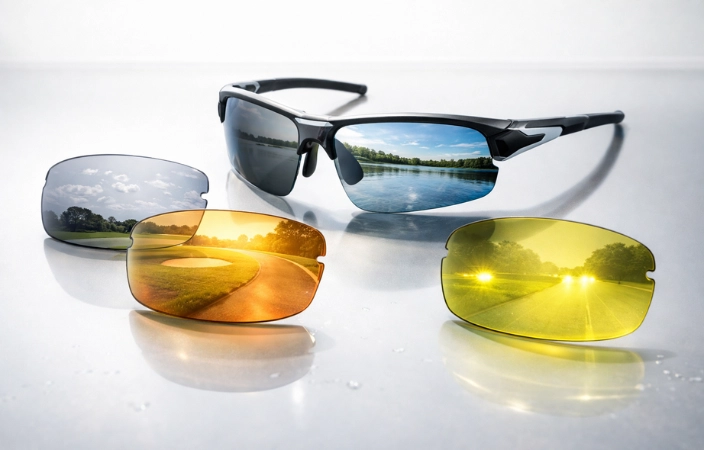
A photochromic lens contains molecules that change structure when exposed to ultraviolet light, darkening the lens, then revert as UV drops. It responds to how bright the conditions are, not to glare orientation.
One lens covers a wide brightness range, which is the entire point. You leave in gloom, the sun comes out over Bellahouston Park, and the lens follows you rather than forcing a choice you made in the hallway.
These are not mutually exclusive. Polarised photochromic lenses exist and work well. They cost more, and most people genuinely only need one of the two properties.
Polarised lenses are excellent at their job and have three real drawbacks, none of which usually appear in the marketing.
None of that makes polarised a bad choice. It makes it a specific choice, correct when your dominant problem is reflected glare off a flat surface.
The same honesty applies in the other direction. Photochromic lenses have limits worth knowing before you buy.
Most tint advice online is written for climates with predictable light. Ours is not one of them, and three consequences follow.
You can leave in flat grey and finish in low bright sun, or the reverse, within an hour. Any fixed tint is therefore wrong for part of the session. This is the single strongest argument for photochromic here, and it is why we recommend it more often in Glasgow than the general literature would suggest.
Contrast-lifting tints in the rose and amber range often do more useful work in Scotland than heavy grey tints, because our problem is more often flat, low-contrast light than overwhelming brightness. A lens that helps you read a dull surface beats one that simply makes everything dimmer.
This is the one strong argument for polarised in a Scottish context. Wet tarmac throws serious glare, and for road cyclists who ride mostly in daylight and do not depend on a screen, polarised has a real case. Weigh it against the bike computer problem honestly.
Tint gets all the attention, but the coatings often make more difference to whether you actually enjoy wearing the thing.
All of these are available on the advanced prescription lenses we fit as standard.
One technical point that catches people out. Sports frames wrap around the face, and a prescription lens in a curved frame needs the correction compensated for that curvature. It is a genuine optical calculation, not a styling detail.
Skip it and the result is edge distortion that most people do not experience as blur. They experience it as eye strain, fatigue or mild nausea on longer sessions, and they usually blame the tint. If you have owned prescription sports glasses that never felt right, this is the most likely explanation.
In young players, visual problems very rarely announce themselves as visual problems. They announce themselves as a child who has “gone off” a sport, who avoids positions requiring ball tracking, or who is described as not concentrating.
Before concluding a child lacks interest or aptitude, it is worth ruling out the possibility that they simply cannot see the game the way their teammates can. Our children’s eyecare service covers this, and where short sightedness is progressing year on year, myopia management can slow that progression and is considerably more useful started early.
Book your comprehensive eye examination or eyewear styling consultation with
Mosspark Opticians today.
They are more comfortable in glare, but not automatically safer. What protects your eyes from sun damage is UV protection, which polarised and non-polarised lenses can both have. Polarisation adds glare reduction on top.
Not by themselves. Polarisation and UV protection are separate features. Check that any sunglasses are labelled UV400 or 100% UV protection, and carry a CE or UKCA mark.
For daytime driving, yes. They cut glare from wet roads and other cars, which is especially useful in Scotland's low autumn and winter sun. Some dashboard and sat-nav screens can look dark through them, and no sunglasses should be worn for driving at night.
Phone and car screens give off polarised light. When the screen is at a certain angle to your lenses, the two filters cancel out and the screen looks dark or patchy. Tilting the screen usually brings it back.
Yes. Polarised lenses are available in most single vision and varifocal prescriptions, so you can see clearly and cut glare in the same pair. We can advise on the best lens and frame for your prescription.
Other Articles from Mosspark Opticians: