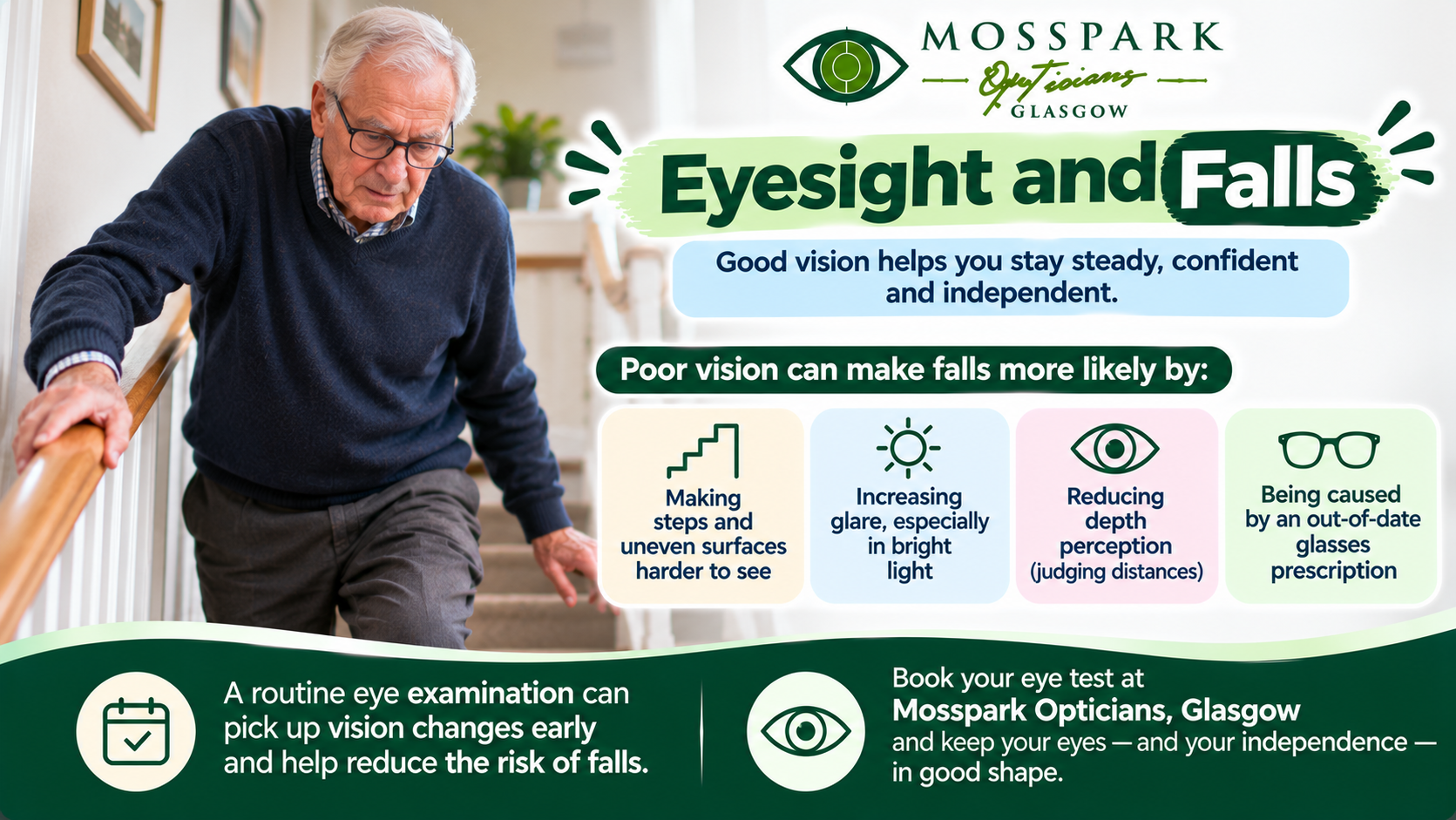

Falls are one of the biggest threats to independence in later life, and the dark, wet Glasgow winter makes them more likely. Eyesight and falls are closely linked, and vision is one of the risk factors that can most often be improved, sometimes simply with up-to-date glasses.
This article is for older people and for the families and carers who worry about them. It explains how vision affects balance and safety, and the practical steps that help.
Its medical name is a subconjunctival haemorrhage. This article explains why it happens, how long it takes to clear, and the signs that mean you should have it checked.
Staying steady depends on three systems working together: the balance organs in the inner ear, the sense of position from the feet and joints, and vision. As the other two become less reliable with age, we depend more on our eyes. Spotting the edge of a step, the height of a kerb, or a rug on the floor all rely on vision, and especially on seeing contrast.
Varifocal and bifocal lenses have the reading part at the bottom. When you look down at stairs or a kerb through that part, the edge of the step is blurred. Research has linked multifocal glasses with more falls on stairs and outside the home in older people.
That does not mean varifocals are unsafe for everyone. It does mean some people are better off with a separate pair of single-vision distance glasses for walking outdoors, or simply learning to lower the head, not just the eyes, on stairs. We are happy to talk this through. Our article on varifocals and reading glasses explains the options.
Families often notice before the person does. Look out for someone who has had a trip or fall, is hesitant on stairs or kerbs, has stopped going out after dark, holds the handrail more tightly than before, or has not had an eye test in more than a year. Changes in vision can also be mistaken for confusion or memory problems, as our article on vision, memory and getting older explains.
On the NHS in Scotland, eye examinations are free for everyone, and people aged 60 and over can usually have one every year. An examination checks not only the glasses prescription but also for cataracts, glaucoma and macular degeneration, all of which can be treated or monitored. If someone has fallen, tell us when you book, so we can pay particular attention to side vision and to how their glasses work for walking.
If an older relative cannot get to the practice on their own because of their health, they may qualify for a free NHS home eye test in Glasgow. We bring portable equipment, and family members are welcome to be there. Find out more about our home visit eye care and our independent opticians in Glasgow.
To book an eye test, at the practice or at home, call us on 0141 427 4040.
Book your comprehensive eye examination or eyewear styling consultation with
Mosspark Opticians today.
Yes. Poor eyesight makes it harder to see steps, kerbs and obstacles, and is one of the most common and most fixable risk factors for falls in older people.
Research has linked multifocal glasses with more falls on stairs and outdoors in older people, because the edge of a step is seen through the blurred reading part. Some people benefit from separate distance glasses for walking.
People aged 60 and over can usually have a free NHS eye examination every year.
Cataracts, glaucoma, macular degeneration, vision loss after a stroke and an out-of-date prescription all increase the risk of falls.
If they cannot get to a practice on their own because of their health, they may qualify for a free NHS home eye test in Scotland.
Other Articles from Mosspark Opticians: