

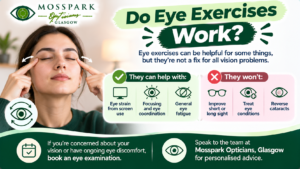

Search online and you will find plenty of claims that eye exercises can improve your eyesight, help you throw away your glasses or reverse ageing eyes. It is an appealing idea. So do eye exercises work? The honest answer is that they help with a few specific problems, but they cannot change your glasses prescription.
This article explains what the evidence shows, so you can decide where to spend your time.
Short-sightedness, long-sightedness and astigmatism are mainly caused by the shape and length of the eye. An eye that is slightly too long focuses light in front of the retina, and no amount of exercise changes the length of the eye. Presbyopia, the need for reading glasses after 40, happens because the lens inside the eye stiffens with age, and exercises cannot make it flexible again.
There is no good evidence that eye exercises, eye yoga or programmes such as the Bates method reduce a glasses prescription. Eye exercises also cannot prevent or treat glaucoma, cataracts or macular degeneration.
Convergence insufficiency
This is a common condition in which the eyes struggle to turn inwards and work together for close work. It can cause tired eyes, headaches, blurring and double vision when reading. Here, targeted exercises genuinely help. Clinical trials have shown that structured vision therapy is an effective treatment for many children with this condition, and it can help adults too.
Some focusing problems
When the focusing system tires quickly or is slow to switch between distance and near, specific exercises can sometimes help, alongside the right glasses.
H3 Recovery after concussion or a stroke
Eye movement and focusing problems after a head injury or stroke can sometimes be helped by exercises prescribed by an optometrist or orthoptist as part of rehabilitation.
These exercises work because they target a specific, diagnosed problem. They are prescribed after an examination and reviewed over time, which is very different from general exercises found online.
Dyslexia is a difference in how the brain processes language and the sounds of words. It is not caused by eyesight, and no glasses or coloured overlay can treat it. Visual stress is about visual discomfort when reading. Some people have both, some have one, and some have neither and struggle for another reason. A child who is struggling with reading may need support from school as well as an eye examination.
A lazy eye (amblyopia) in childhood is usually treated with glasses and, where needed, patching or eye drops to make the weaker eye work harder. Treatment works best while vision is still developing in early childhood, which is why children’s eye examinations matter. Some newer treatments use games and activities, but these are prescribed and monitored by eye care professionals.
If reading gives you headaches, double vision or tired eyes, the cause can usually be found with a full eye examination. Sometimes the answer is updated glasses. Sometimes it is a binocular vision problem that responds to targeted exercises. For children whose short-sightedness is increasing, myopia management can slow its progress, which exercises cannot.
Find out more about our eye examinations at our independent opticians in Glasgow.
To book an eye examination, call us on 0141 427 4040.
Book your comprehensive eye examination or eyewear styling consultation with
Mosspark Opticians today.
Eye exercises cannot change short-sightedness, long-sightedness, astigmatism or the need for reading glasses. They can help specific problems, such as convergence insufficiency.
tress describes discomfort and distortion when reading, such as words that seem to move, blur or flicker, often with headaches or tired eyes.
No. There is no good evidence that eye exercises reduce a glasses prescription. Going without glasses you need can cause eye strain and is unsafe for driving.
Targeted exercises prescribed after an examination can help convergence insufficiency and some focusing problems. The 20-20-20 rule helps with comfort during screen work.
Regular breaks, such as the 20-20-20 rule, and blinking fully can make the eyes more comfortable during screen use, although they do not change your prescription.
A lazy eye is usually treated with glasses and patching or eye drops in childhood. Some newer game-based treatments exist, but they are prescribed and monitored by eye care professionals.
Other Articles from Mosspark Opticians:
Holiday Closure
We’ll be closed from 26th October to 9th November, reopening on 10th November.
Thank you for your understanding!
Team Mosspark Opticians