
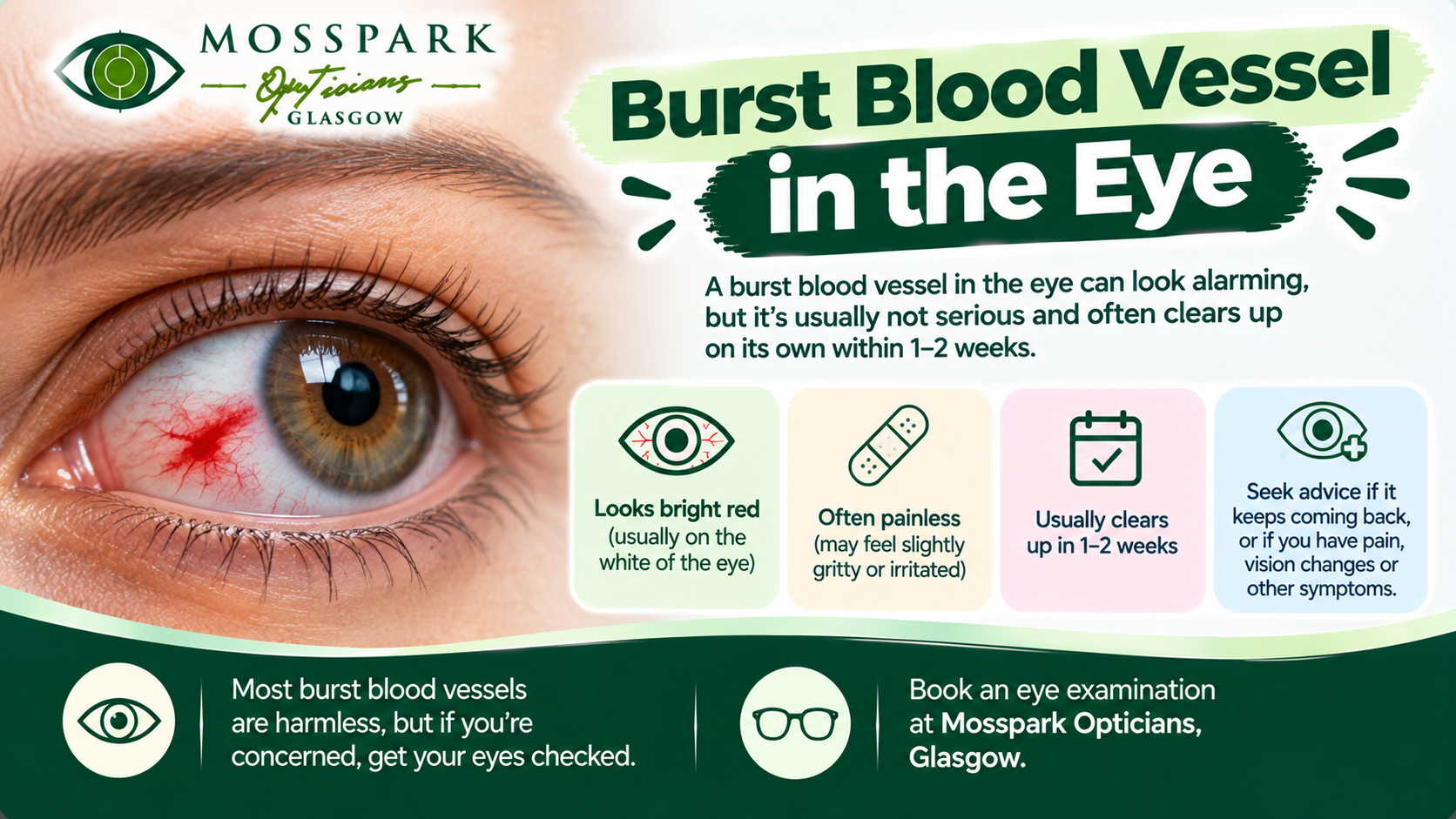


Waking up to find a bright red patch on the white of your eye is alarming. It often looks dramatic, and family members are usually more worried than the person it belongs to. In most cases, though, a burst blood vessel in the eye is harmless and clears up on its own.
Its medical name is a subconjunctival haemorrhage. This article explains why it happens, how long it takes to clear, and the signs that mean you should have it checked.
The white of the eye is covered by a thin, clear membrane called the conjunctiva, which contains many tiny blood vessels. When one of these breaks, a small amount of blood collects underneath the membrane. Because the membrane is clear, the blood shows up as a vivid red patch.
The blood sits on the surface of the eye, not inside it, which is why it usually does not affect vision or cause pain.
Most people feel nothing, or at most a mild scratchy sensation as the patch first appears. Vision should be normal. The patch does not spread across the coloured part of the eye.
Most burst blood vessels clear within one to two weeks, and larger ones can take two to three weeks. Like a bruise on the skin, the patch may spread slightly at first and change from red to orange or yellow as it fades. No treatment is needed. Lubricating eye drops can help if the eye feels scratchy, and it is best to avoid rubbing it.
Even without worrying symptoms, it is worth having an eye examination if:
A burst blood vessel is a flat, well-defined red patch. A general redness across the eye, with grittiness, discharge or pain, is more likely to be conjunctivitis, inflammation or an infection, and needs a different approach. Our article on red eyes explains the main causes and when each needs treatment.
In Scotland, your optometrist is usually the best first place to go with an eye problem. We can examine the eye closely to confirm it is a simple burst blood vessel, check your eye pressure and the health of the inside of the eye, and advise on whether you should see your GP about your blood pressure or medication. As Independent Prescribing optometrists, we can also treat many other causes of a red eye in the practice, without a separate GP appointment.
Find out more about our eye examinations and our Glasgow Southside opticians.
If you are worried about a red eye, call us on 0141 427 4040.
Book your comprehensive eye examination or eyewear styling consultation with
Mosspark Opticians today.
Usually not. A burst blood vessel on the white of the eye is common and normally clears on its own. Get it checked if there is pain, blurred vision, an injury, or if it keeps happening.
Most clear within one to two weeks, and larger ones within two to three weeks. The patch may change colour as it fades, like a bruise.
Common causes include coughing, sneezing, straining, rubbing the eye and blood-thinning medicines. High blood pressure can also be a cause, and sometimes there is no clear reason.
No treatment is usually needed. Lubricating drops can ease any scratchiness. Avoid rubbing the eye.
In Scotland, an optometrist is a good first place to go with an eye problem. If the bleed may be linked to blood pressure or medication, they may also advise you to see your GP.
Other Articles from Mosspark Opticians:


Holiday Closure
We’ll be closed from 26th October to 9th November, reopening on 10th November.
Thank you for your understanding!
Team Mosspark Opticians