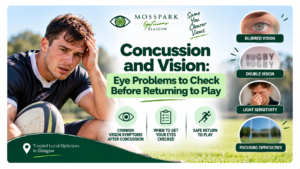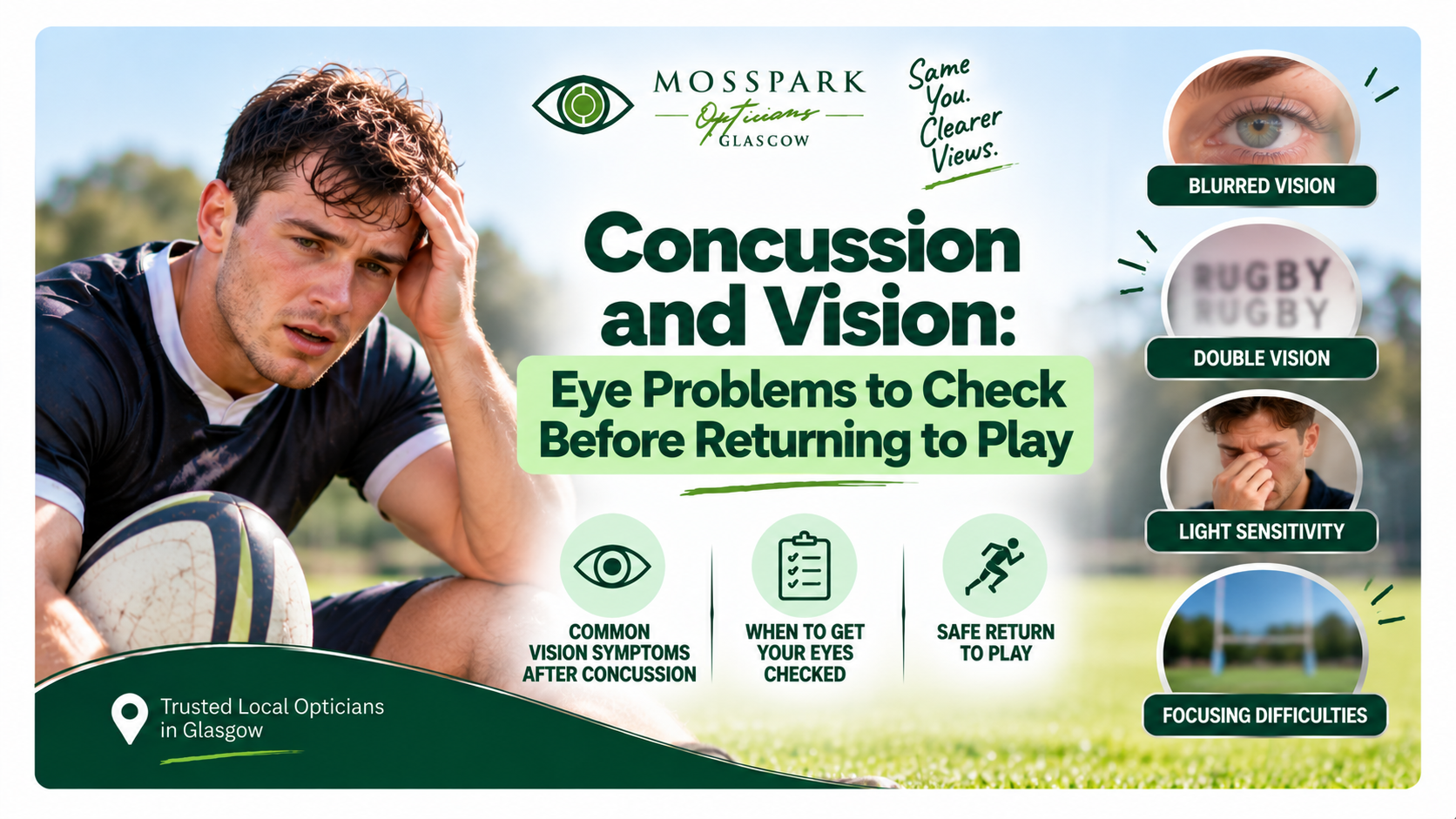


Concussion is a brain injury, and the brain does most of the work of seeing. It is no surprise, then, that concussion vision problems are among the most common symptoms after a knock to the head. They are also among the most easily missed, because a player can look fine, say they feel fine, and still be struggling to focus, track a ball or read a page.
This article is for players, parents and coaches. It explains what to look for, when it is an emergency, and where an optometrist fits into recovery.
Blurred vision and difficulty focusing
The focusing system can become sluggish, so reading, screens and close work feel harder and more tiring than usual.
Double vision and eyes not working together
Concussion can disrupt how the two eyes team up. The most common problem is difficulty turning the eyes inwards to look at something close, which can cause double vision, eye strain and headaches when reading.
Tracking and eye movements
Smooth, accurate eye movements are what let a player follow a ball in flight or scan the pitch. After a concussion, these can become slower or less accurate.
Light and motion sensitivity
Bright light may become uncomfortable, and busy visual environments such as supermarkets, crowds or fast-moving screens can bring on dizziness or nausea.
Seek urgent medical help if a player has new or worsening double vision, a severe or increasing headache, repeated vomiting, a seizure, increasing confusion or drowsiness, weakness or tingling in the arms or legs, or neck pain after a head injury.
These are signs of a more serious injury and need emergency assessment, not an eye test.
Once a player has been medically assessed, an optometrist can help in several ways. We can check that the knock has not injured the eye itself, and measure how well the eyes focus, work together and track. We can also make sure any glasses prescription is up to date, since a player straining with an old prescription will struggle more during recovery.
If visual symptoms are persisting, we can advise on managing reading and screen time, and refer on to specialists such as orthoptists where that would help. As Independent Prescribing optometrists, we can also treat many eye problems in the practice
A player can feel ready to return while their vision is still lagging behind. Sport is visually demanding: judging a high ball, reading a tackle or tracking a pass at speed all depend on the systems concussion affects. If visual symptoms have not settled, they deserve attention before competition, alongside the graduated return-to-sport programme.
We work with rugby, football and cycling clubs across Glasgow. Concussion and vision sits naturally alongside our eye injury prevention talk for clubs and our guidance on protective eyewear for club sport. If your club would like either, get in touch with our Gqlasgow Southside optician team.
If a player’s vision has not settled after a concussion, call us on 0141 427 4040.
Book your comprehensive eye examination or eyewear styling consultation with
Mosspark Opticians today.
Yes. Concussion can cause blurred vision, difficulty focusing, double vision, problems tracking moving objects, and sensitivity to light and busy environments.
For most people they settle as the concussion recovers. Anyone with symptoms after 28 days should see their GP, and an eye examination can help identify ongoing focusing or eye movement problems.
For most people they settle as the concussion recovers. Anyone with symptoms after 28 days should see their GP, and an eye examination can help identify ongoing focusing or eye movement problems.
New or worsening double vision after a head injury is a red flag. Seek urgent medical help by calling 999 or going to A&E.
No. Concussion is diagnosed and managed medically. An optometrist can assess vision problems during recovery and check for injury to the eye itself.
The Scottish Sports Concussion Guidance advises a graduated return, with no return to competition before 21 days from the day of the injury.
Other Articles from Mosspark Opticians: