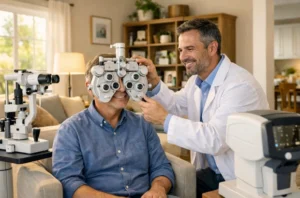

When something goes wrong with your eye, the hardest part is often knowing where to go. A&E feels like an overreaction for a red eye. The GP might not have an appointment for a week. And most people simply don’t know that their optician can handle the majority of urgent eye problems — often faster, and with better equipment, than either.
So here’s a straightforward guide to the five most common urgent eye situations, how serious each one is, and what to do about it.
This is the most urgent symptom on the list. Any sudden change in your vision — total loss, partial loss, a dark curtain or shadow across part of your field, or a sudden significant blur — needs to be assessed immediately, not tomorrow.
Possible causes range from retinal detachment and retinal vein occlusion to acute glaucoma and, occasionally, stroke-related visual loss. Several of these are time-critical: the difference between treatment within hours and treatment within days can determine whether vision is recovered or permanently lost.
|
Do not wait on this one Sudden vision loss is the one symptom where speed genuinely changes the outcome. Call us immediately on 0141 427 4040. If you can’t get through, go straight to A&E or your nearest hospital eye department. Do not wait to see whether it improves overnight. |
Eye pain covers a wide spectrum, and the character of the pain matters. A gritty, scratchy discomfort usually points to a surface problem — a foreign body, a corneal abrasion, or severe dry eye. A deep, aching pain behind or around the eye is more concerning, particularly if it comes with nausea, headache, or blurred vision, which can indicate acute angle-closure glaucoma.
Pain accompanied by light sensitivity (photophobia) can suggest iritis or keratitis, both of which need prompt diagnosis and prescription treatment. As an Independent Prescribing practice, we can examine, diagnose, and prescribe for most of these directly — including the anti-inflammatory and antibiotic medications needed — without you waiting for a GP appointment first. Our dry eye and blepharitis clinic also handles the chronic surface conditions that cause recurring discomfort.
The most common urgent presentation we see, and the one most people default to the GP for. A red eye can be anything from harmless to serious:
The equipment matters here. We examine the eye under a slit lamp with magnification, use fluorescein staining to reveal corneal damage invisible to the naked eye, and can measure eye pressure directly. A GP consultation room typically has a torch. That’s the practical difference in how precisely the cause can be identified.
Floaters — the drifting specks, cobwebs, and threads you notice against a bright background — are usually harmless and extremely common, especially after 50. Flashes of light in your peripheral vision are more significant, because they indicate the vitreous gel inside the eye is tugging on the retina.
The combination that needs same-day assessment: a sudden increase in floaters, new flashes of light, or a shadow or curtain effect creeping across your vision. Together, these can indicate a retinal tear or detachment. Caught early, a tear can often be treated with laser to prevent full detachment. Left too long, it becomes a surgical emergency with a worse prognosis.
We assess these with a dilated retinal examination — drops to widen the pupil for a full view of the peripheral retina — supported by OCT scanning for a cross-sectional view of the retinal layers.
A foreign body — grit, metal, wood dust, an eyelash — that won’t flush out with clean water needs professional removal. Trying to dig it out yourself risks scratching the cornea or pushing the object deeper.
Metal fragments in particular need prompt attention: they can oxidise and leave a rust ring on the cornea within hours, which requires removal alongside the fragment itself. If you work with power tools, angle grinders, or machinery and something has flown into your eye, don’t wait to see whether it settles.
|
Chemical exposure is the exception If a chemical has splashed into your eye, do not call first. Flush the eye immediately with clean running water for at least 15–20 minutes, then go straight to A&E. Time spent on the phone is time the chemical is doing damage. |
This is the part most people don’t know. We accept direct referrals from GPs for eye problems, and we can refer directly to the hospital eye department when something needs surgical or specialist care — without you going back through a GP first. That means for the majority of urgent eye issues, our Glasgow optician practice is the right first port of call, not A&E.
The practical benefit: you get seen by someone who specialises in eyes, using equipment designed for examining eyes, and if it turns out you need the hospital, we send you there with a full clinical picture already documented — which usually means faster treatment when you arrive.
For everything else, call us first. If it’s something we can’t manage, we’ll tell you honestly and direct you to the right place.
If something is wrong with your eye and it doesn’t feel like it can wait, call or message us on 0141 427 4040. Call ahead rather than walking in — it lets us prioritise properly and have the right equipment ready when you arrive.
Book your comprehensive eye examination or eyewear styling consultation with
Mosspark Opticians today.
For most urgent eye problems — red eye, pain, foreign bodies, flashes and floaters — an optician with the right equipment can assess and treat faster than A&E. Chemical exposure, penetrating injury, and significant trauma should go straight to A&E.
An Independent Prescribing (IP) optometrist can diagnose and prescribe medication for many acute eye conditions directly, including infections, inflammation, and allergic reactions, without a GP referral.
Yes — we accept direct referrals from GPs, and we can also refer patients on to the hospital eye department when specialist or surgical care is needed.
No — call us and explain what's happening, and we'll do what we can to help whether or not you've been seen here before.
Try flushing gently with clean water first. If it won't come out, don't rub or dig at it — call us and we'll remove it safely. Metal fragments in particular need prompt attention to prevent a rust ring forming on the cornea.
Outside our hours, NHS 24 (111) or your nearest A&E are the right first call for anything urgent. Don't wait until we reopen if something feels serious.
Other Articles from Mosspark Opticians: