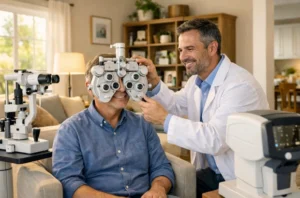

Here’s something I hear all the time when a patient visits us for the first time: “I had no idea an optician could do all this.” And I get it. For most people, an optician means one thing – you go in, you read the chart, you leave with a new pair of glasses. Maybe you pick up some contact lenses on the way out. That’s the full experience, and it’s been the full experience their whole life.
But opticians in Glasgow – and specifically, good independent practices – can do a lot more than that. And I think it’s worth laying out exactly what “a lot more” actually looks like, because some of it might genuinely change how you think about eye care.
This is the foundation, and it’s where the biggest gap sits between a rushed ten-minute test and a thorough 45-minute examination. Both will tell you whether you need glasses. Only one will check the actual health of your eyes in any meaningful detail.
A full examination includes pressure checks for glaucoma risk, OCT retinal imaging to detect changes years before symptoms appear, and a detailed look at the internal structures of the eye using a slit lamp. Glaucoma in particular is worth understanding: it causes no pain, no blurred vision, and no symptoms at all until permanent damage has already occurred. The only way to catch it early is to look for it specifically – and a quick chart-reading appointment simply doesn’t do that.
If you’re unsure whether you’re eligible for a free test, our guide to free NHS eye tests in Scotland covers exactly who qualifies – the short version is that every Scottish resident is entitled to one, regardless of age or income.
This is the one that surprises people most. If you wake up with a red, painful eye, or an infection, or an allergic flare-up, most people’s instinct is to call the GP and wait for an appointment. But an Independent Prescribing (IP) optometrist can diagnose and treat a wide range of acute eye conditions directly – and issue prescription medication on the spot, the same day.
What Independent Prescribing actually means for you An IP-qualified optometrist can examine, diagnose, and prescribe medication for acute eye conditions like infections, red eye, and allergic reactions – without you needing to see a GP first. It means faster treatment, from someone who specialises in eyes rather than general practice. |
That includes things like bacterial conjunctivitis, allergic eye reactions, dry eye flare-ups, and foreign bodies. For anything that needs hospital-level care – severe trauma, chemical burns, or conditions outside our scope – we can arrange a private referral directly to ophthalmology, with everything we’ve found passed along, rather than sending you back to a GP queue first.
Dry, gritty, tired eyes are one of the most common complaints we see, and for most people the only advice they’ve ever been given is “try some drops from the chemist.” That works for mild cases, but for a lot of patients it’s a bit like putting a plaster on a problem that actually needs a proper look. Our dry eye and blepharitis clinic goes well beyond that – we assess the quality of your tear film, check for blocked meibomian glands, and build a treatment plan specific to what’s actually causing your symptoms, not just masking them.
If this sounds familiar, we wrote a more detailed piece on why drops alone might not be enough that’s worth a read.
A good optician in Glasgow should be genuinely set up for children – not just willing to see them. That means picture-based tests for pre-readers, a pace that suits younger patients rather than adult appointment slots, and a proper conversation with the parent about what was found and what it means. Our children’s eyecare service is built around exactly that, and every child under 16 in Scotland is entitled to a free annual NHS eye test.
What’s changed in recent years is the rise of myopia – short-sightedness – in children, partly driven by increased screen time and less time outdoors. If your child’s prescription is creeping up year on year, that’s not just an inconvenience – higher myopia later in life carries genuinely elevated risks of conditions like retinal detachment and glaucoma. Myopia management uses specific lens designs and strategies to slow that progression while they’re still growing, rather than just correcting what’s already there. It’s one of the most important developments in children’s eye care, and most parents have never heard of it.
For more on when to book that first appointment, our guide on what age children should get their eyes tested covers the practical side.
A proper contact lens fitting is a clinical appointment, not a quick add-on to an eye test. It involves measuring the curvature and tear film of your eye, trialling lenses on the day, teaching insertion and removal at your pace, and building in a follow-up to check how your eyes are actually responding. Daily, monthly, toric for astigmatism, multifocal for the over-40s – there are more options than most people realise, and the right choice depends on your eyes, not just your preference.
This is where the difference between a chain and an independent practice shows up most visibly. A curated frame collection from boutique and independent brands means genuine variety – not the same handful of mass-market styles you’ve already seen on three other faces this week. Pair that with state-of-the-art lenses and honest dispensing advice, and the difference between “glasses that’ll do” and “glasses I actually love wearing” is a real one.
If you want a feel for the range before you visit, our lookbook and brands page are a good place to start.
Two services that patients genuinely don’t expect an optician to offer: sports vision – prescription eyewear and advice built specifically for football, rugby, golf, and other sports where standard frames don’t cut it – and home visit eye care for patients who can’t easily get to the practice, whether that’s due to mobility, age, or simply not being able to leave the house. Both are services that a good optician in Glasgow should have in their toolkit, and both are ones most people only find out about by accident.
None of the above happens easily in a ten-minute, high-volume model. The Slow Optometry approach isn’t a marketing line – it’s the practical reality of what it takes to do eye care properly: longer appointments, the same optometrist seeing you each time, no sales targets driving what gets recommended, and the clinical freedom to offer services like IP prescribing, myopia management, and dry eye treatment that most chain practices simply can’t fit into their schedule.
We wrote a more detailed take on why Glasgow locals are choosing independent opticians if you want the fuller picture.
In a sentence A good optician in Glasgow should be able to test your eyes, treat your eye conditions, manage your children’s changing vision, fit contact lenses properly, offer eyewear that’s genuinely distinctive, and see you at home if you can’t get to the practice – all under one roof, all without rushing. |
If any of the above sounds like more than what you’re currently getting from your optician, we’d genuinely love to show you how we do things differently. Book an appointment or just give us a call on 0141 427 4040 – whether it’s a routine check, a second opinion, or something that needs looking at today, we’ll make time for you.
Book your comprehensive eye examination or eyewear styling consultation with
Mosspark Opticians today.
Beyond standard eye tests and glasses, a comprehensive optician should offer contact lens fittings, dry eye and blepharitis treatment, children's eye care, myopia management, emergency eye care with independent prescribing, sports vision, home visits, and private referrals to ophthalmology when needed.
An Independent Prescribing (IP) optometrist can diagnose and prescribe medication for many acute eye conditions - including infections, red eye, and allergic reactions - directly, without a GP referral. It's often faster and more specialist than the GP route.
Myopia management uses specific lens designs and clinical strategies to slow the progression of short-sightedness in children while they're still growing. Higher myopia in adulthood carries increased risks of serious eye conditions, so slowing it early makes a meaningful difference.
Independent opticians typically offer longer appointments, greater continuity of care with the same optometrist, no corporate sales targets, and specialist services like dry eye clinics and myopia management that high-volume chain models rarely have time to deliver.
No - if you have an urgent eye issue, call us and we'll fit you in as soon as we can, whether or not you've been seen at the practice before.
Yes - we offer home visit eye care for patients who can't easily get to the practice, whether due to mobility, age, or other circumstances. Get in touch and we'll arrange a time.
Other Articles from Mosspark Opticians: