
Many parents assume that if there were a problem with their child’s eyes, they’d notice – or that the school will catch it. In reality, children rarely complain about their vision because they have nothing to compare it to. They simply assume everyone sees the way they do. That’s why knowing when to book a children’s eye test matters so much.
Here’s a Glasgow parent’s guide to children’s eye tests – when to start, what screening does and doesn’t cover, and the signs worth watching for.
Children can have their eyes examined far earlier than most parents expect – there’s no minimum age, and no need for them to know their letters or even to talk. We can assess a young child’s eyes using pictures, shapes and lights. As a general guide, it’s worth having your child’s eyes tested by around the age of three or four, and certainly before they start school. If there’s a family history of eye problems or a squint, bring them sooner.
In Scotland, children are offered orthoptic vision screening at around four to five years of age, usually in their first year of school. This is valuable – it’s designed mainly to detect amblyopia (“lazy eye”) and squints at an age when treatment is most effective. But it’s a screening check, not a full eye examination. It won’t always pick up longsightedness, focusing difficulties or the early stages of short-sightedness, and it’s a one-off rather than ongoing monitoring.
|
Screening is a safety net, not the full picture Pre-school screening catches some problems, but a comprehensive eye test looks at the whole picture – vision, focusing, eye coordination and eye health – and can be repeated as your child grows. |
A huge proportion of what children learn comes through their eyes. Undetected vision problems are easily mistaken for difficulty concentrating, falling behind at school, or simply not trying. Picking up an issue early means it can usually be corrected while the visual system is still developing – something that becomes much harder after the age of seven or eight.
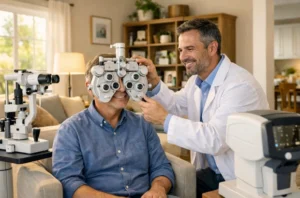
No. This is one of the most common worries we hear. We adapt the test to your child’s age and stage, using matching games, pictures and lights rather than letter charts for younger children. The appointment is relaxed and reassuring, and we keep it fun.
Yes. All children under 16 in Scotland are entitled to a free annual NHS eye test, and 16–18s in full-time education are covered too. There’s no cost to you for the examination.
Short-sightedness (myopia) is becoming more common in children, partly linked to more time on screens and indoors. Beyond stronger glasses each year, high myopia raises the risk of eye problems in later life. That’s why we offer myopia management – evidence-based treatments that can slow how quickly a child’s short-sightedness progresses.
We’re a family-run optician in Glasgow’s Southside and we genuinely enjoy seeing younger patients. Our unhurried approach suits children well – there’s no production line, just one friendly optometrist taking the time to make your child feel at ease. We also offer consultations in English, Urdu and Punjabi.
Book your comprehensive eye examination or eyewear styling consultation with
Mosspark Opticians today.
There's no minimum age. We can assess very young children using pictures and lights. Many parents bring children from around age three, and certainly before starting school.
Screening is helpful but limited - it mainly checks for lazy eye and squints at one point in time. A full eye test is more comprehensive and can be repeated as your child grows.
Yes. All children under 16 are entitled to a free annual NHS eye test, as are 16–18s in full-time education.
We use matching games, pictures, shapes and lights instead of letter charts, adapting everything to your child's age so the visit stays relaxed and fun.
Other Articles from Mosspark Opticians: