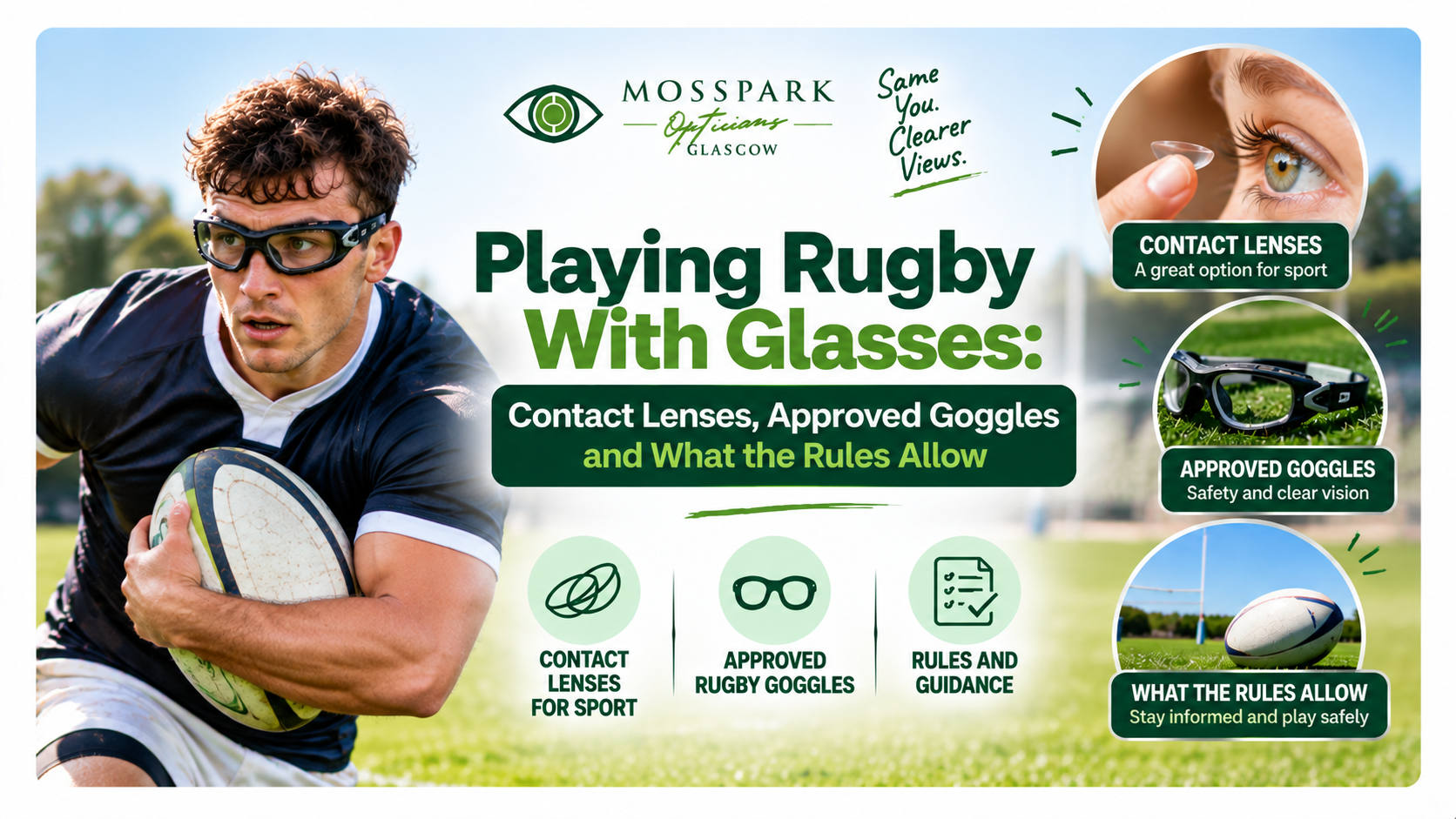


Every season we hear from players, and from parents of young players, who have been told they cannot take the field in their glasses. That is right: playing rugby with glasses is not allowed. But nobody should have to play half-blind either. There are two good options, and most players who wear glasses can play safely and see clearly with one of them.
Rugby’s laws restrict what players can wear, to protect both the wearer and everyone they come into contact with. Everyday glasses have rigid frames and lenses that can break in a tackle or a ruck, cutting the wearer or another player. Even sports frames designed for other games are not permitted.
For most players, soft contact lenses are the simplest answer. They move with your eye, give you a full field of view for reading the game, and cannot fog or break. Daily disposable lenses are usually the best choice: a fresh pair every match, and if one is lost in a scrum, you simply put in a spare.
Mud and rugby go together, so hygiene matters. Put your lenses in with clean, dry hands before you change into kit, never rinse lenses or cases with water, and take them out after the match. Hard or rigid gas permeable lenses are generally not a good choice for contact sport, as they are more easily dislodged.
Since 2019, World Rugby has allowed specially designed goggles at all levels of the game, after a trial that began in 2014. They were developed to take prescription lenses without increasing the risk of injury to the wearer or to other players.
Only goggles that meet World Rugby’s specification are permitted. Ordinary sports goggles, swimming goggles and safety glasses are not. If you are considering goggles, check with your club, and talk to us about fitting prescription lenses.
H3 Who goggles suit
If you have good vision in only one eye, protecting it is essential in a contact sport. Please talk to us before playing. Approved goggles were developed partly with players like you in mind, and we can advise on the safest way to keep playing.
Fingers in rucks and mauls, boots and heads all come close to the eyes. The injuries we see most often are scratches to the front of the eye, cuts around the eyelid and bruising from a blow. A black eye can look worse than it is, but it can also hide damage inside the eye that is not visible from the outside.
After any blow to the eye, seek help the same day if there is reduced or blurred vision, double vision, new flashes or floaters, blood visible in the front of the eye, or pain when moving the eye. For knocks to the head, our guide to concussion and vision explains what to look for before returning to play.
Many children manage daily contact lenses well, often from around the age they start playing contact rugby, although every child is different. We assess whether your child is ready, teach them to put lenses in and take them out, and check they can manage on their own. For children who are not ready, approved goggles are an alternative.
We fit contact lenses and advise on eyewear for rugby players of all ages as part of our sports optician service, and we work with clubs on protective eyewear for club sport. Find out more about our opticians in Glasgow’s Southside.
Book your comprehensive eye examination or eyewear styling consultation with
Mosspark Opticians today.
No. Glasses are not permitted in rugby. Players who need vision correction can wear soft contact lenses or World Rugby approved goggles.
Treat as an immediate emergency any suspected penetrating injury or embedded object, any chemical in the eye, sudden loss or blurring of vision, severe pain, an irregular pupil, blood visible in the coloured part of the eye, double vision, or an eye that does not move normally. New flashes or floaters after a blow also need same-day assessment even if vision seems normal.
Yes. Soft contact lenses are widely worn in rugby, and daily disposables are usually the best choice.
Since 2019, World Rugby has allowed specially designed goggles at all levels of the game. Only goggles that meet World Rugby's specification are permitted.
Many children manage daily contact lenses well. An optician can assess whether your child is ready and teach them to handle lenses safely.
Seek help the same day if you have blurred or double vision, flashes, floaters, blood in the eye or pain moving the eye. For a suspected head injury, follow concussion guidance and seek medical help.
Other Articles from Mosspark Opticians: